By Kevin O’Brien
If you’re not, the guys in these pictures are. The pictures are courtesy of SA-Kuva, which is Finnish for Finnish Army Photo — the army archives there have just released a large quantity of wartime photos. (If you have a Russian-spec Mosin or other ex-Russian bangstick with the stamp “SA” in a rectangle, you have an artifact of a Finnish tactical victory over their would-be slavemasters from the USSR). The captions are, alas, in Finnish, a language little spoken this side of the Gulf of Bothnia.
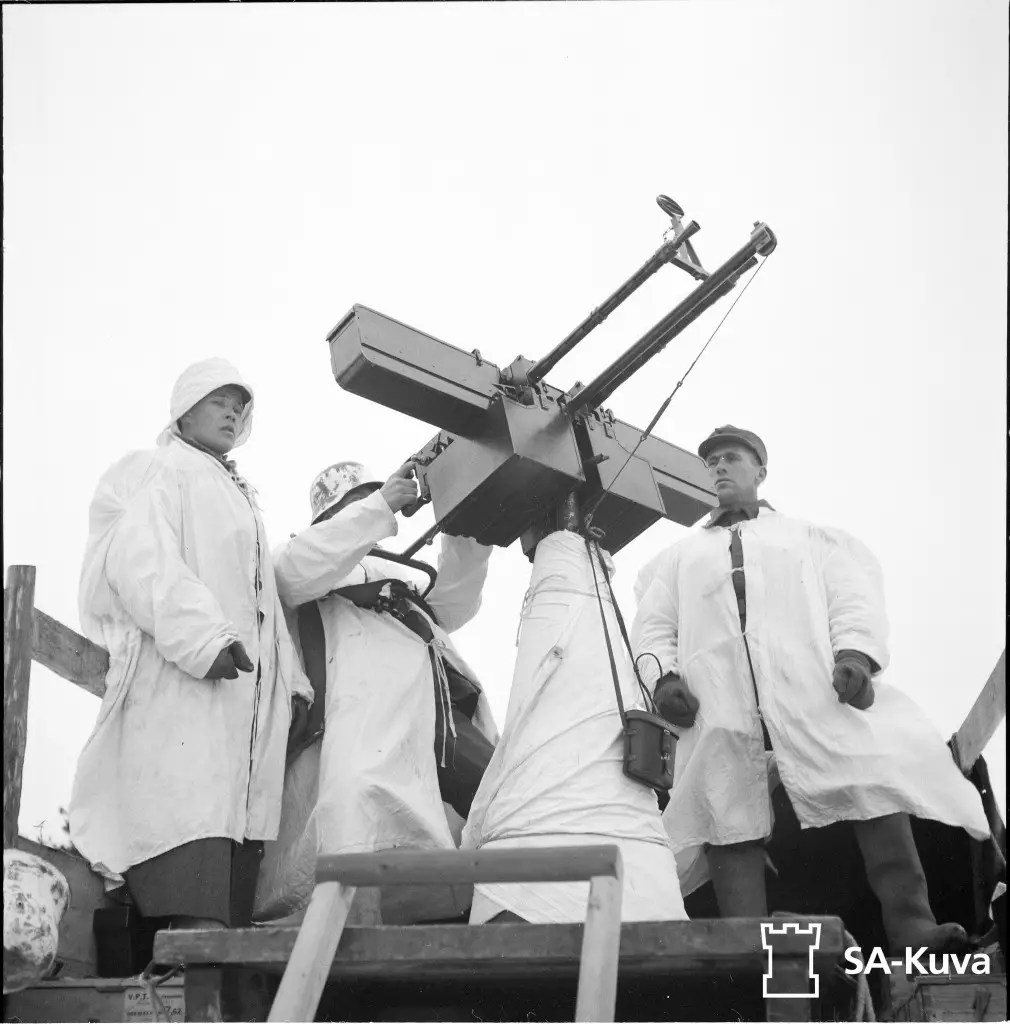
These pictures are reprinted here with permission. Don’t forget that you can click to enlarge them even further. First up we have MG gunners training(?) with what looks like some kind of training rig. The Finnish caption is: “IT-tykki lossin luona. Vuosalmi. 1939.12.18.” OK, so our translation is: AA-gun alongside cable, at Vuosalmi (a town on the coast), 18 Dec 39. Note for general use that an IT-tykki is an AA gun, and a TT-tykki is an AT gun.

Here’s another picture, this one showing a Russian BT-5 tank that has fallen into the clutches of the Finns. Can’t make heads nor tails of the caption, though: “Hovista 0,5 km etelään kenttäkanuunan yhdellä laukauksella suoralla suuntauksella tuhottu hyökkäysvaunu. Syskyjärvi 1940.01.10.” Out of that, we get the date (10 Jan 40), the place Syskyjärvi, and a reference to 0.5 kilometers. It may be in the caption, but in English we can’t tell whether the tank was knocked out, or just abandoned by bugging-out Russians.

And next up, we have two truly classic weapons: the Russian knock-off of the Krupp anti-tank gun, here in 45mm, and the Finnish soldier standing over it armed with an ex-Russian semiauto rifle. Original caption: “Ryssiltä vallattu hv-tykki etulinjassa suomalaisten käytössä. Kollaanjoki. 1940.01.01.”
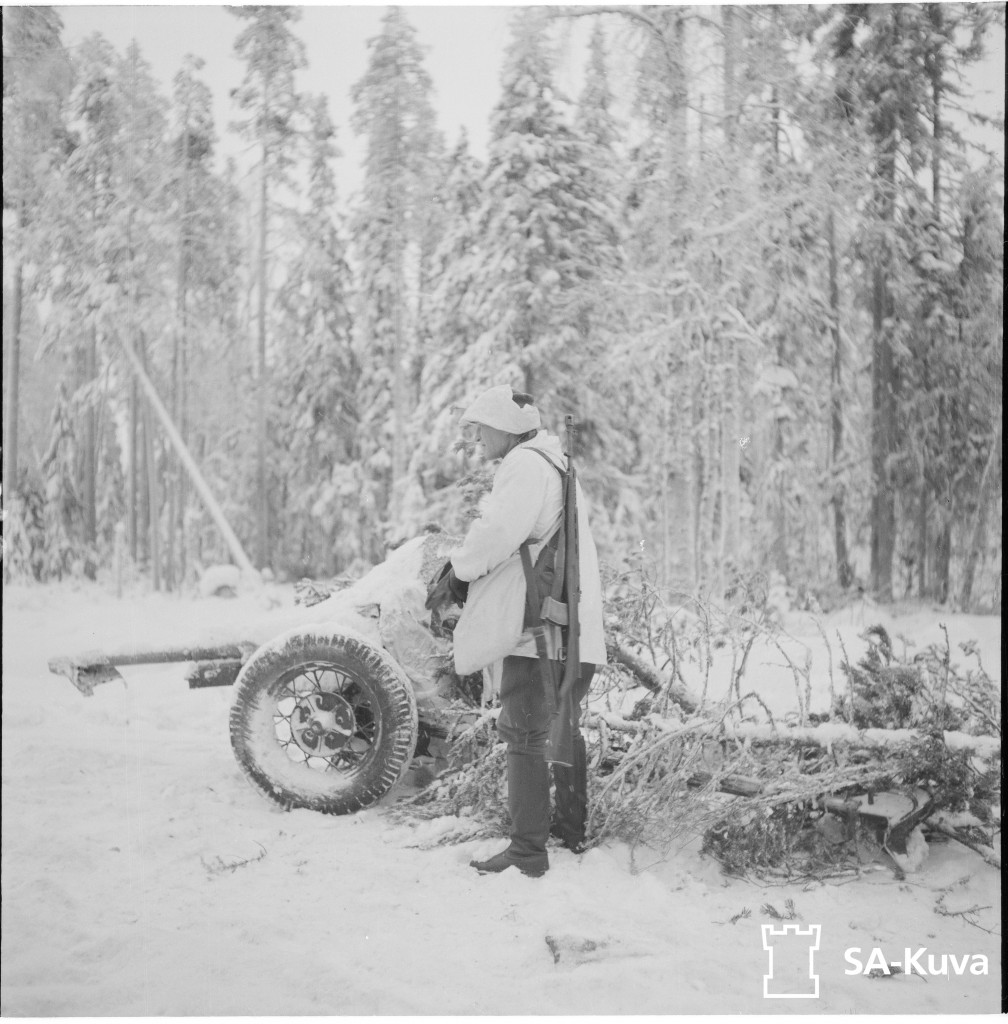
The rifle is a very rare one, a Simonov AVS-36. It was a select-fire rifle chambered for the 7.62 x 54R cartridge, and fed from a 15-round magazine. Soon after its adoption, it was supplanted by the Tokarev SVT-38 and -40 rifles, which were made in both semiauto (SVT) and select fire (AVT) versions. Tokarev rifles are noteworthy when encountered, but compared to AVS-36s they are as commonplace as Mausers. Interesting note about these Russian interwar rifles — when you do find one that is not a post-’68 import, it will probably have an SA stamp, as Finland sold off their stocks before the GCA of 1968 required imported milsurps to be marked with the importer’s name and city. They are, at least the semiauto Tokarevs are, a rare GI bringback, as they were used occasionally as captured weapons by the Germans, and occasionally by ragtag Chinese formations in the first year of the Korean War.
The Russian units that hit Finland, and got creamed, are widely reported, based on contemporary Soviet propaganda, to have been second-string units. But their heavy armament with state-of-the-Red-art semi-auto rifles — most of which wound up in Finnish custody, as did the surviving Ivans — argues to the contrary. These were first-line units with first-line equipment. What benefited the Finns was the recently concluded military purges, which eliminated almost everyone in the Red Army at the rank of Colonel or higher — and intimidated the living Lenin out of the survivors. The new, high-tech arms pushed into surface by the brilliant Tukhachevskiy before his murder were too much for an army purged of its best and brightest to maintain, and the Russians reverted to WWI weapons, supplemented by hastily adopted submachine guns. (Which had been part of Tukhachevskiy’s reforms, but were simple enough for a dumbed-down service to grasp).
The Finns fought not one, but two wars against the Russians (1930-40 and 1942-44), and they beat the Russians in battle after battle. Man for man, they were by far the better army, but in Stalin’s pungent phrase, “quantity has a quality all its own.” In both wars, the Finns were overwhelmed and agreed to humiliating concessions.
But the Russians didn’t get what they wanted — a return of Finland to Russian suzerainty, as it had been prior to the collapse of the Empire.
Hat tip: Alan Taylor’s In Focus blog at The Atlantic.
 Scattered Shots