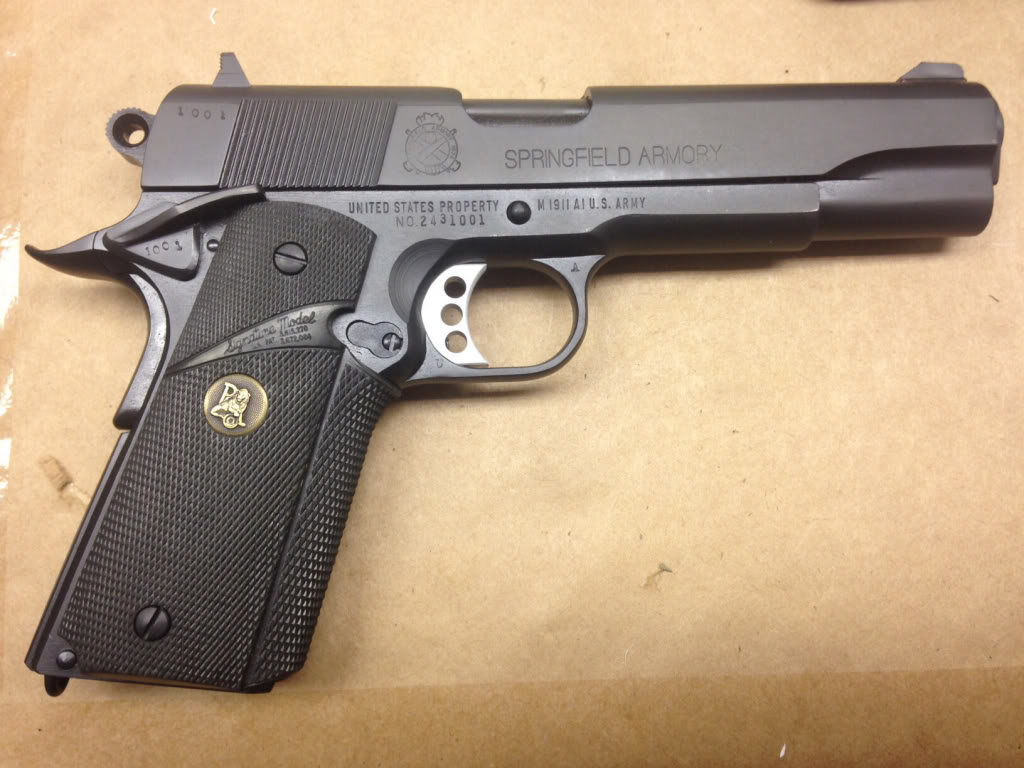
After the adoption of the 9mm M9 in 1985, some special units within the DOD were loath to give up their .45 M1911A1 pistols.
US Marine Corps
The MEU(SOC) pistol dates back to at least 1986, the year when the rest of the USMC was to receive its first M9 pistols. USMC Colonel Robert Young laid out the original specifications as follows:
Standard 5″ barrel throated for reliability;
Standard GI recoil spring guide and plug;
Standard extractor;
Novak sights;
Standard trigger of 4 to 4.5 pounds;
Beavertail-style grip safety;
Commander hammer;
Extended thumb safety;
No firing pin safety;
Lanyard loop on butt;
Grooved front strap;
Exterior edges dehorned;
Beveled magazine well;
Matte black finish; and
A Wilson #47 7-shot magazine.

There were at least four major variations of the MEU(SOC) pistol built in-house by the Match Armorers at Quantico by the USMC’s Rifle Team Equipment (RTE) Shop/Precision Weapons Section (PWS). The MEU(SOC) pistol did not receive an unique NSN (1005-01-370-7353) until 29 January 1993. The designation M45 CQBP was not formally issued until 2010.
In 1998, the Commanding Officer of 1st Force Reconnaissance Company, Lt. Col. Robert J. Coates, requested that the MEU(SOC) pistol be upgraded to include: higher quality internal parts, an integral Mil-Std-1913 rail; and the elimination of the match barrel requirement. While PWS responded positively to the suggestion, nothing solid ever came of it.
After the US invasions of Afghanistan and Iraq, the PWS at Quantico simply couldn’t keep up with the demand for building and maintaining the MEU(SOC) pistols when they had so many other pressing priorities, particularly to the Scout-Sniper community. Reportedly, PWS was only producing ~60 a year at the time. It was clear that if the USMC wanted to keep the M1911A1 in service, they were going to need to buy new Commercial, Off-The-Shelf (COTS) pistols instead of building them on a piecemeal basis. You can find multiple solicitations for a COTS version of the MEU(SOC) pistol going all the way back to at least January 2003.
On 3 March 2003, the Marine Corps Special Operations Command’s (MARSOC) immediate forerunner, MCSOCOM Detachment 1, was created, with Lt. Col. Robert J. Coates in command. At the time, Det. 1 was merely an experiment to see if the USMC wanted to make a full commitment to creating a SOCOM contingent. Please remember that the MEU(SOC) Marines were never part of SOCOM, and there had been great distrust by the USMC brass of losing existing manpower to SOCOM going all the way back to the latter’s formation in April 1987.
When Det. 1 was created, there was a great rush to equip the unit’s 81 Marines and 5 Navy Corpsmen for their new duties. The unit’s armorer Gunnery Sergeant Mark S. Kitashima reported that he started with an empty arms room, a chain, and a lock. The Marine Corps originally suggested that Det. 1 use the standard M9 pistol, but that weapon was quickly rejected as being unreliable and underpowered. The MEU(SOC) pistol was considered, but dropped from consideration given its immediate unavailability and lack of sustainability. While MEU(SOC) units only went through around 5,000 rds per training/deployment cycle, Det. 1’s pre-deployment training alone was expected to put the pistols past their 10,000 rd overhaul requirement.
Next, Marine Corps Systems Command (MARCORSYSCOM) provided 50 Springfield Professional Models, but these were found unsatisfactory. The pistols lacked the desired tritium night sights; were fitted too tightly, and the S&A magazine well interfered with seating the in-service Wilson #47 magazines fitted with thin slam pads. The Professionals were ultimately donated to Force Recon to supplement their supply of MEU(SOC) pistols.

Instead, Det. 1 ended up working with Kimber for a variant of their LAPD SWAT pistol, which became known as the Interim Close Quarters Battle (ICQB) pistol. The specifications for the Interim CQB pistol included the following:
•Modified 1911 pistol;
•No requirement for a suppressor;
•Series 1 pistol. No passive safety is required;
•The slide has front and rear serrations;
•Rear sights are Novak Lo Mount;
•Front sight is dovetailed—sights have tritium inserts;
•Standard length guide rod;
•Sights set for M1911 Ball at twenty-five yards;
•The magazine well is beveled;
•Flat Mainspring housing with lanyard loop;
•High beavertail safety with memory pad;
•Ambidextrous thumb safety;
•Standard magazine release;
•Pachmayr GM-45CS grips. (Note that this was superseded. The guns were ultimately fitted with the Gunner Grips provided by Rob Simonitch/Strider Knives, in coyote brown);
•Exterior is manganese phosphate in accordance with MIL-STD-171;
•Threshold requirement that a seven-shot group will not exceed four inches at twenty-five yards with M1911 ball;
•Trigger will be free of creep and 5 lbs. +/-1 lb;
•The pistol will withstand the firing of 50,000 rounds without overhaul;
•Markings will conform to MIL-STD 130, Identification of US Property; and
•The serial numbers will be unique to Det.-1.
Curiously, the first 86 Kimber pistols were ordered via the US Army’s Natick Soldier Systems Center. (Natick also helped procure much of Det. 1’s other equipment.) The sole-source notice for the Kimber ICQB posted on FBO back on 4 May 2003.
https://www.fbodaily.com/archive/2003/05-May/04-May-2003/FBO-00317033.htm

After delivery, the ICQB frames had Dawson light rails fitted. Some pistols had the Kimber grip safety replaced with either an Ed Brown or an STI unit. Wilson #47 magazines were substituted for the Kimber OEM magazine.
After MARSOC was formed in 2006, Det. 1 was disbanded.
Here is a list of all of the FBO references I can find for COTS MEU(SOC)-type pistols leading all the way to the 2012 award for the Colt M45A1. Please note that the dates are for the notices, not when they actually appeared on the FBO website, which was generally a day or two later.
January 16, 2003 – .45 Caliber Combat Handgun (Pre-solicitation notice from Marine Corps Systems Command)
https://samdaily.us/archive/2003/01-January/18-Jan-2003/FBO-00240751.htm
April 8, 2003 – MEU(SOC) .45 CALIBER COMBAT HANDGUN (Solicitation notice from Marine Corps Systems Command)
https://samdaily.us/archive/2003/04-April/10-Apr-2003/FBO-00299158.htm
May 2, 2003 – Pistols (Sole Source notice from US Army Robert Morris Acquisition Center, Natick Contracting Division for the 86 Kimber ICQB)
https://samdaily.us/archive/2003/05-May/04-May-2003/FBO-00317033.htm
February 15, 2005 – MEU(SOC) 45 caliber pistols (Sole Source notice from Marine Corps Systems Command for 150 Springfield Professional Models)
https://samdaily.us/archive/2005/02-February/17-Feb-200/FBO-00751606.htm
November 7, 2008 – MEUSOC .45 PISTOL (Sources Sought notice from Marine Corps Systems Command)
https://samdaily.us/archive/2008/11-November/09-Nov-2008/FBO-01702235.htm
March 19, 2010 – M45 MEUSCOC Pistol (Pre-solicitation notice from Marine Corps Systems Command)
https://samdaily.us/archive/2010/03-March/19-Mar-2010/FBO-02095403.htm
October 8, 2010 – Request for Proposal for Commercial Production and Delivery of the Close Quarter Battle Pistol (CQBP) (Marine Corps Systems Command)
https://www.neco.navy.mil/synopsis/detail.aspx?id=283111
Candidates were submitted by Colt, Karl Lippard Designs, and Springfield Armory.
July 19, 2012 – Award Notice Close Quarter Battle Pistol (CQBP) (Marine Corps Systems Command)
https://www.neco.navy.mil/synopsis/detail.aspx?id=364822
The initial order was for 4,036 M45A1 pistols with potential follow-ons for up to 12,000 pistols.
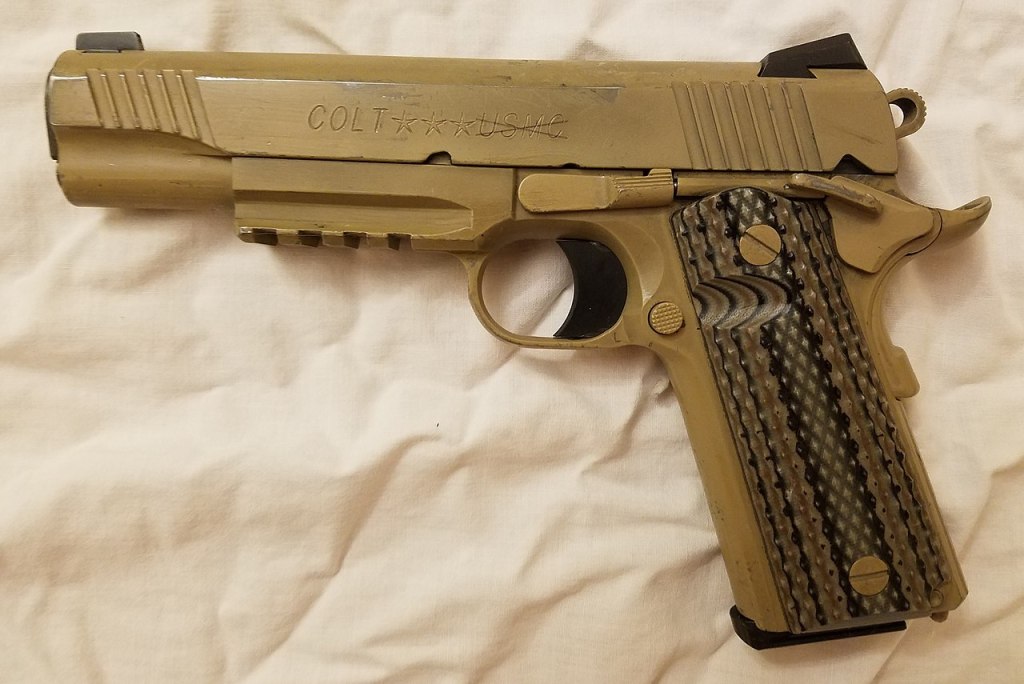
MARSOC began to replace their M45A1 with SOCOM-supplied Glock 19 as early as February 2015. Initially, this was up to the choice of individual operators, but the transition went across the board in 2016. The USMC’s Recon Battalions, Security, and Emergency Services Battalions replaced their remaining M45A1 pistols with the SIG-Sauer M18 in October 2022.
Delta/CAG
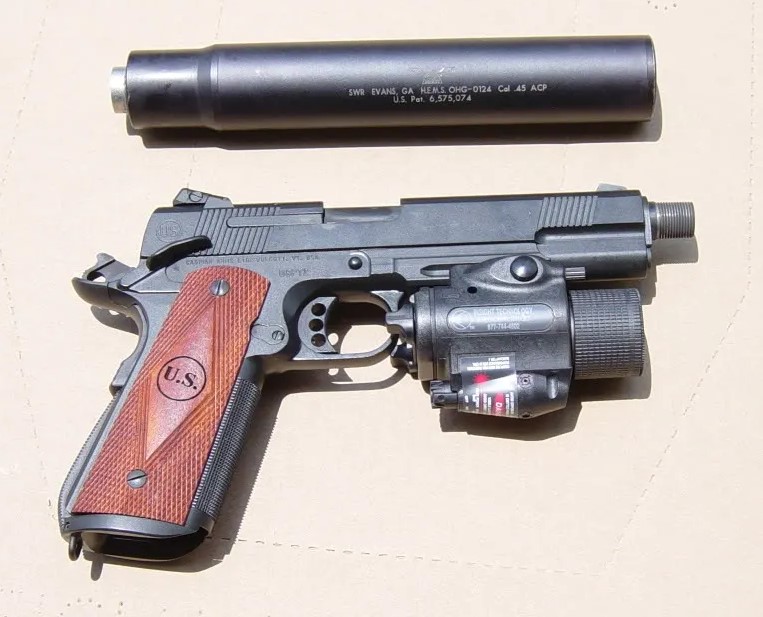
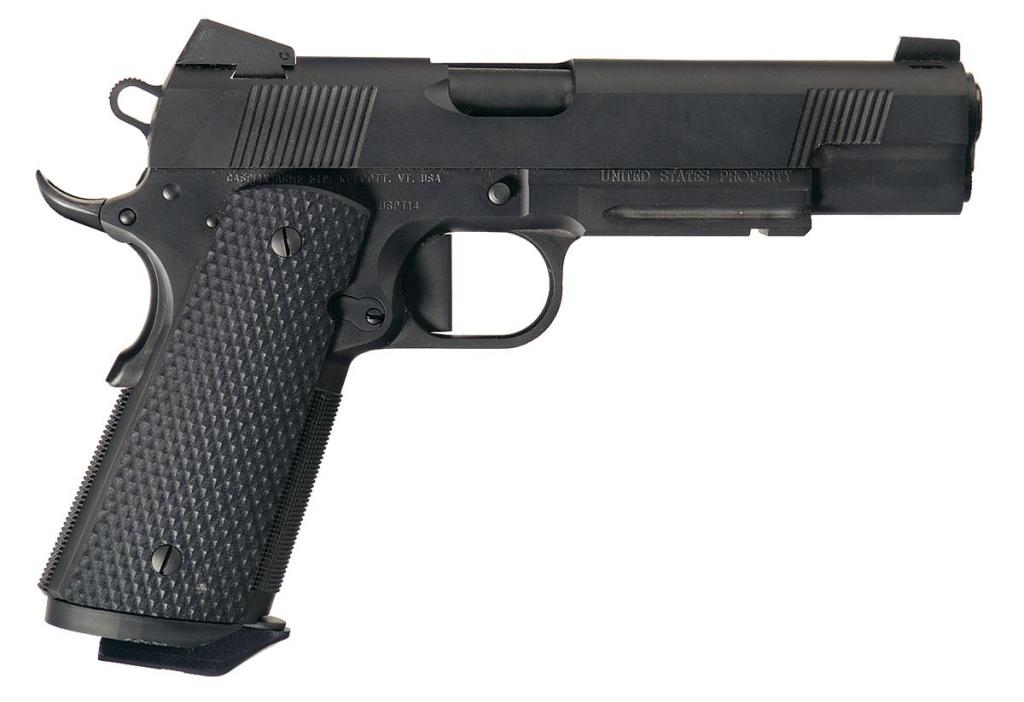
Delta’s initial issue pistols were modified M1911A1 National Match (NM) pistol builds. Once the supply of NM pistols and parts began to dwindle in the 1990s, the NM slides, and later, frames were replaced with Caspian-produced parts.

2001 – Larry Vickers and Ken Hackathorn approached Heckler & Koch about the possibility of building an improved M1911A1 for Delta. These plans were dashed by the commercial introduction of M1911A1-type pistols by SIG-Sauer and Smith & Wesson in early 2002.
2004 – 275 pistols using the Caspian Race Ready Recon frame and slide were assembled by the Springfield Armory Custom Shop.
2006 – A number of STI 2011 Tactical 5.0 in .40 S&W were purchased for combat field testing alongside Glock 22 pistols.

2007/2008 – The STI 2011 pistols were returned to the factory, and Delta standardized on the Glock 22.
US Army Special Operations Command
After the invasion of Afghanistan in Autumn 2001, there was a great agitation for the reissue of M1911A1 pistols to US Army Special Operations Command (USASOC) in place of the issue M9. Leading the charge was MSG Steve Holland of the 5th Special Forces Group (5SFG).
2003 – USASOC received a supply of warstock M1911A1 pistols for distribution to various SFG.
2004 – In early 2004, the USASOC Small Arms Force Modernization representative requested that the US Army Marksmanship Unit (AMU) develop a .45 Auto combat style pistol out of commercially available off-the-shelf components. This pistol was to meet the needs of US forces stationed in Iraq and Afghanistan who wanted a more powerful sidearm to use in close combat situations than what was currently available. In October, the AMU assembled five “M1911A2” concept pistols using Caspian frames and slides. Four were assembled using the Recon single-stack frame while one was built off of the double-stack Race-Ready frame.
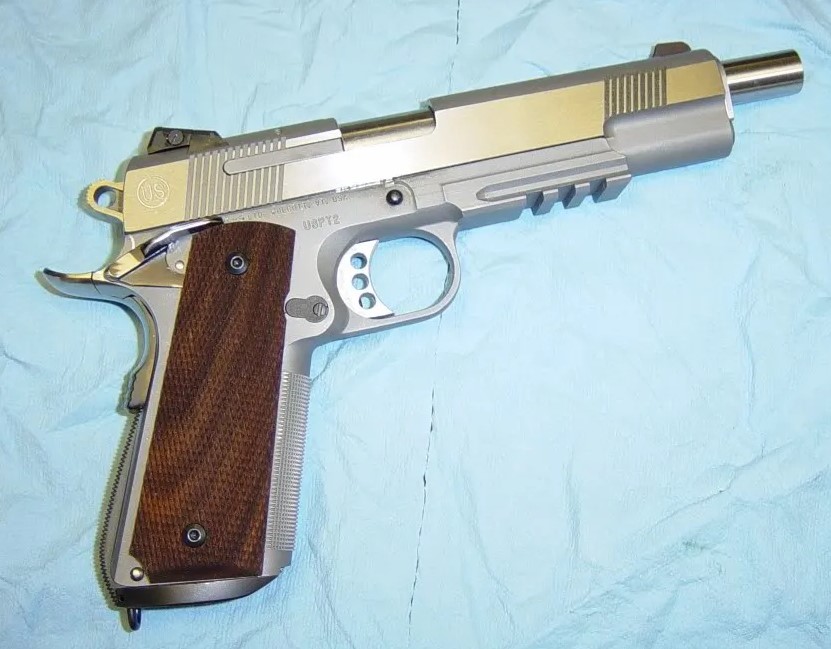

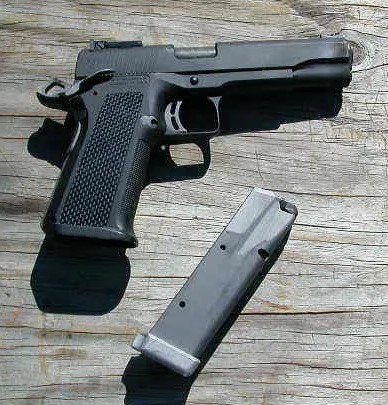
2005 – Circa 2005, the 3rd Special Forces Group requested M1911A1s to provide a handgun for their Soldiers deploying to Afghanistan not otherwise authorized an M9. The AMU modified 550 warstock pistols with bullseye trigger jobs, Novak fixed rear sights, front sights, and beavertail grips. In October, Novak’s converted at least two pistols for 5SFG Green Berets, A month later, Novak’s was contacted about the possibility of converting 27 more pistols. After Wayne Novak loaned out a personal sample pistol for T&E in December, no further action was taken by 5SFG.

2006 – The original five M1911A2 were returned to the AMU after combat field use. An additional 10 were assembled with the last completed in November.

2016 – USASOC’s surplus M1911A1 were finally withdrawn.
 Scattered Shots