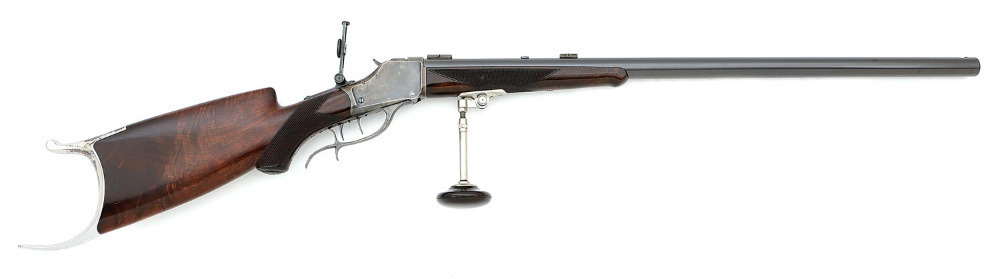
By: Harry M. Pope
with an introduction by Townsend Whelen
THE POPE MUZZLE LOADING SYSTEM
By Townsend Whelen
THERE is a class of riflemen who indulge in shooting offhand at 200 yards at a bull’s-eye target, either the German ring target or the Standard American target. This form of shooting was introduced into this country by the Germans, and is termed Schuetzen shooting. Some Schuetzen riflemen develop extraordinary skill in this sport, and of course extremely accurate rifles are in demand. There is no restriction as to the rifle except that it must be fired offhand without artificial support. The Schuetzen rifle is a type by itself. It is usually a very heavy rifle, sometimes as much as 13 pounds. It has a long, heavy barrel, and a comparatively light charge, the .32-40 and .38-55 cartridges being those usually used. The bullet is usually either loaded ahead of the shell into the rifling by means of a bullet seater so that it is already seated in the rifling centrally before being fired, and the shell full of powder loaded separately after the bullet; or else the bullet is loaded from the muzzle by means of a false muzzle and bullet starter, and shoved down by means of a ramrod to a point just in front of the chamber, the shell full of powder only being then loaded from the breech in the usual manner.

Among the makers of fine Schuetzen rifles one man stands supreme. Mr. Harry M. Pope has long held the reputation of being the most skilled maker of rifle barrels in the world. Of late years he has been making all kinds of rifle barrels, and his product has never been approached by any other maker. The barrels are made by hand entirely, and Mr. Pope will often spend a week on the cutting of one barrel. But it is in his Schuetzen barrels that his work is seen at its best. The Pope muzzle loading Schuetzen system as made by Mr. Pope himself is the very best in the world for accuracy up to 600 yards, bar none. It might also be said that his high-power, long-range target barrels have never been surpassed for long-range shooting, although they are seldom seen because almost all long-range shooting is confined to military shooting and military competitions where the straight government made, military rifle is prescribed. Mr. Pope will guarantee his Schuetzen barrels, muzzle loading, to shoot all their shots into a 2 1/2 inch group or closer at 200 yards, and I have yet to hear of one of them which has not made good. It is thought that Mr. Pope’s own description of his system and methods will be of interest to the reader in view of the extraordinary results obtained with it, and also because this description is out of print and can no longer be obtained anywhere. It is therefore to a certain extent historical, and is appended here both on account of its interest, and so that it will not be lost entirely.
POPE RIFLE BARRELS
By H. M. Pope
By profession I am a mechanical engineer and a skillful workman; for recreation and by preference, a “rifle crank.” I first made a barrel (entirely on a foot lathe) because I could not buy what I wanted: i.e., a .25 caliber, which I made in 1887, before this size was manufactured. My first charge was a straight shell holding 25 grains of powder and a 100-grain bullet, then a shorter one with 20 or 21 grains of powder and 85-grain bullet. Finding the making of a sufficient number of these shells on a foot lathe an arduous task, I rechambered and swaged down a .32-20 shell. I used this shell for some time, but on making my first muzzle loader, I swaged down a .38 extra-long, center-fire shell, holding 30 grains, and using bullets up to 120 grains. With this rifle I did my best shooting under National Rifle Association rules. Being troubled with bursting shells, I finally swaged down .32-40 everlasting shells, using 35 grains. This did good work muzzle loading, but had passed the limit for accuracy for breech loading with black powder. Shortly after this I accidentally injured my barrel and abandoned this rifle for a 13-pound rifle with set triggers, the state of my pocketbook at prize matches giving an unanswerable argument that this gave better results than the lighter arm, and later experience fully bears this out, and I find that I can still shoot a “practical” rifle with the rest, some “arms over your head” cranks to the contrary. (Proof, five dead deer with five cartridges, standing and running, all in thick woods at usual distances.) The conditions of target shooting and field shooting bear no resemblance to one another, the most difficult change being not the change in arm, but the change from a deliberate aim at a target to the snap shot at game. Therefore when you shoot at a target use every refinement known to increase your scores, as almost every refinement known for target use is impracticable in the field or woods.
During the period above mentioned I became interested in, and thoroughly convinced that, the so-called Schalke system, devised by Wm. Hayes and Geo. Schalke, possessed advantages for offhand shooting that placed it far in advance of any other system of loading. This system I adopted, improving on Mr. Schalke’s method of manufacture, and altering somewhat the form of cut, though retaining the essential features. The above mentioned heavy rifle, as well as the last .25 caliber, were so made. Their performance was so good that I had to fit out my intimate shooting friends, and their improvement in shooting was so marked that I began to be besieged by outside parties to make barrels for them. This, for a long time, I refused to do, but finally these inquiries became so numerous, and Mr. Schalke’s death occurring about this time, I consented, with the result that my barrels are now in the hands of the most expert offhand shots in the country, and are making scores that are unsurpassed, and every man who shoots a Pope improves his scores. Don’t believe me, but watch the papers and see if this is not so.
The Pope system, so called, is, as previously stated, nearly the same as the Schalke, the difference being in the shape of the cut, and that my barrels are cut to correct shape, while Mr. Schalke’s were leaded. Mr. Schalke’s rifling had eight flat grooves and eight narrow lands, with sharp corners to grooves. My rifling is here shown. (See Fig. 93.) It has eight wide grooves, which are on a radius about three times the radius of the bore, and has the corners rounded out, so dirt is easier removed, and it is cleaner in use. This groove is cut just deep enough to clean the bore in center and give a depth at corners of about .004 inch, which is about one-half the depth of the Schalke, but which is of ample depth, and works cleaner, and leaves less to depend on upset of the bullet, and is therefore more reliable. The lands are very narrow (about one-fifth to one-sixth the width of the groove). The bullet is made with a base large enough to fill grooves completely, and the body of practically the same diameter as the bore. This gives a form that is gas tight, loads very easily (being assisted in this by the narrow lands and choke bore), and on upset, instead of the body of the bullet meeting only sharp lands and these cutting into the body of the bullet more or less unequally, it is immediately held to place by the nearly flat center of the broad grooves, and swells out into grooves equally and perfectly central: consequently is accurate.
In this system a false muzzle and starter are used, and the lubricated bullet, seated from the muzzle, the shell with powder being afterward inserted in the ordinary way. In doing this the labor is very light, as the shooter has to handle nothing over a few ounces weight, the rifle standing in the loading stand. By the simple act of pushing the bullet home the sharp flat base of the bullet cuts the dirt down behind it, and does so exactly alike each time, giving a uniformly clean barrel without the labor of cleaning. This is also less labor than the ordinary way of seating a greased bullet in the breech, having to invert the rifle and generally sustaining its weight while so doing. The result of these things is that we attain all the accuracy of patched bullets, and in ordinary hands more, without the labor of cleaning.
Other things being equal, the man who tires himself least does the best shooting in the long run, and if this is accompanied by increased accuracy of the rifle, he has a great advantage over his fellows who do otherwise.
Fig. 94 The Pope false muzzle and bullet starter.
A properly made barrel, loaded in this way, will shoot 10-shot groups at 200 yards that will average about 1 1/4 to 1 1/2 inches less in diameter than the same or an equally good barrel shot dirty, bullet seated from the breech, while one using bullets seated in the shell is so far out of the game as to have no chance whatever on a string of any considerable number of shots, if otherwise he is an even match for his competitors.
One and one quarter to 1 1/2 inches does not sound much, but on the fine ringed targets now in use it means points. I have before me a good muzzle-loading group, .32 caliber, 10 shots, 200 yards. On German ring target it counts 250. Another group, shot breech loading, bullet seated in the breech, same load, is but 1 inch larger in diameter and is the best group I ever saw shot under these conditions. It counts 245. On the Columbia target the scores are respectively 12 and 21; on the Standard American 120 and 115. The difference between average groups is still more marked, averaging fully 7 or 8 points on German ring target. On this no comment is necessary.
For steadiness in shooting, I have fired 130 consecutive shots in 10-shot strings, measuring from centers of groups 104 inches, an average of exactly .8 inch per shot. The largest group was 3.75 inches across from center to center of outside shots, and measured 9 11/16 inches. The smallest group was 1.8 inches across and measured 6 inches. All but two of the shots would cut into a 3-inch circle.
Fig. 95 Pope bullet loaded from the muzzle, showing smooth and perfect base
An advantage that a bullet loaded from the muzzle will always have over one loaded from the breech is shown in Fig. 95. This is an enlarged view of a .32-caliber bullet seated from the muzzle. Notice the perfect base, as the lands cutting forward into the bullet left it nearly perfect. Contrast it with a bullet seated in the breech by means of a bullet seater in the ordinary way (see Fig. 96). Here the lands cutting backward into the bullet drag the burrs behind, leaving an uneven and serrated base. If this bullet is not perfectly centered these burrs will be longer on one side than on the other. As these burrs leave the muzzle, the gas escapes first from the short side, tipping the bullet to the opposite side, in which it is assisted by the longer burrs holding the bullet back; the result is an uneven, wobbling flight. The greatest essential for perfect shooting is to deliver the bullet perfectly from the muzzle; that being done, atmospheric conditions and gravity alone govern its flight; the result is accurate shooting.
To illustrate, a group was shot at 200 yards, machine rest, with as perfect bullets as I could select, another on same holding with bullets very badly mutilated at the point; these two grouped closely, a 3-inch circle holding all. Another group was then shot with bullets very slightly filed on one edge of the base, but otherwise perfect; this caused imperfect delivery, and the group was 8 inches in diameter. Weather conditions were good.
The base band of my bullets is broad and sharp, and of full size; the starter centers it perfectly, and fits it to rifling with a perfect base; the shape of the grooves hold it central on upset, and it delivers perfect from the muzzle. No other method will do this.
Fig. 96 Pope bullet loaded from the breech, showing burrs forced out on the base
My barrels are all (unless specially ordered) cut with a gain twist, and are so bored and rifled as to have a slight, but gradual, taper from breech to muzzle. This, besides keeping bullets perfectly under control, in connection with the narrow lands (which cut through the bullet easily), makes loading very easy, and very materially increases accuracy. A bullet pushed through from the breech is tight all the way, there are no loose places, and this result is attained by close, careful workmanship, no emery being used; the result is a barrel with a long life. Whenever practicable I chamber and make all cross-cuts before rifling; then I fit a bushing to the chamber and bore and rifle it with the barrel and false muzzle. As the rifling is then the last cut made in the barrel, I am absolutely certain that there can be no burrs across the grooves, a very common fault.
The advantages of the gain twist are two: 1st — The twist being less at the breech, gives less friction to the bullet; it therefore starts easier and quicker, giving the powder less time to burn on in front of the chamber, which therefore fouls less than in a barrel of uniform twist at the same necessary muzzle pitch. 2nd — The-slight change in angle of rifling, in connection with choke boring, effectually shuts off any escape of gas and prevents gas cutting, which is another cause of imperfect delivery.
The advantages of the Pope system are briefly summed up as follows :
1 — Accuracy.
2 — Light labor.
3 — Seating the bullet centrally without deforming the base, and fitting it perfectly to the bore.
4 — The shape of the grooves holding the bullet central on upset.
5 — Non burning-on qualities of the gain twist.
6—Perfect workmanship.
7 — Ability to load from either the breech or muzzle, and to clean and inspect from the breech.
8 — The ability to shoot any charge desired by inserting shell first, and loading both powder and bullet from the muzzle.
To produce the quality of work that I do, the methods employed in factories producing work in large quantities are impossible; that is to say, that this method of interchangeable parts must leave some leeway for slight inaccuracies to ensure parts assembling. In my work such looseness of fit would be fatal to the results attained. False muzzles, for instance, it is utterly impossible to make perfectly interchangeable, neither is it possible for automatic machinery to produce the same quality of work as a skilled workman with brains behind. The automatic machine does more and does it cheaper, but the quality is not there. Therefore I do all nice work by hand, in the very best manner I know how. Nothing is slighted. This is slow work and takes expensive men. Naturally I cannot compete with factory work in price, but, quality considered, my price is very low.
The Pope muzzle-loading outfit consists of barrel, false muzzle, starter, ramrod, Pope special muzzle-loading mould, and lubricating pump. Barrels will be furnished of almost any length and weight, within about 3 to 6 ounces limit of variation up to 8 pounds, 2 ounces, for 32-inch, No. 4 Octagon, .32-caliber barrel. I consider for 200yard, offhand work a barrel of about 7 3/4 pounds, 30 inches long, and round as the best adapted. This I consider my standard, and recommend it as giving the best average results. For caliber for offhand work I prefer a .28, .32, or .33.
The weight of powder charges are the drawn shell full. This can be decreased by the use of everlasting or special shells, or by using less powder and an air space. Weights of B. L. bullets are those intended to seat in the shell. Barrels are cut with a pitch correct for the bullet they are intended to use. Shorter bullets can be used in a barrel cut for the long one, but not the reverse. It is oftentimes better to use the lighter bullet. Unless specially ordered I shall use my own judgment in cutting the barrel.
Fig. 97 Pope double machine rest with telescope sight, Ballard rifle in position for firing to use the lighter bullet.
It will be noticed that two guarantees are given as to the size of the group at 200 yards. There is absolutely no difference in the qualities of barrel or workmanship. I have a long trip to make to test, and in my guarantee have to make allowance for adverse weather conditions, sometimes having to make several trips to the range to secure the desired results. I never alter a barrel in testing; it is a matter of ammunition only. If tested you see what has actually been accomplished with fine appliances, and know exactly what load did it. If untested, you, unless very expert, can hardly expect to equal at once the results of my machine rest, and may have to do some experimenting (when you become accustomed to the system, not before), to determine the best temper of bullets, etc. You are liable to get as close a group on one guarantee as another, as it is largely a matter of weather conditions. If weather is good I get close groups; if weather is cold and wind tricky they are not so good. It is perfectly obvious that I cannot guarantee to furnish as close a group as the barrel is capable of shooting, though I might happen to do so. I believe all my barrels are capable of shooting closer than 2-inch groups with favorable weather conditions.
The Pope double machine rest is shown in Fig. 97. More information can be derived from its use in a few hours than can be had by ordinary rest shooting by an ordinary shooter in as many weeks, as, if at all carefully used, it has no human errors of holding and pulling. The results, therefore, are those due to rifle, ammunition, and weather only; the man is out of it except so far as his loading of the rifle and judgment of the wind are concerned. The mounts are all adjustable and clamp to the barrel, no screw holes or marring of the barrel being necessary. They take barrels of all ordinary sizes without change, the forearm being removed while testing. In use two stout posts are set deeply in the ground, the firmer the better, and are braced together. A smooth level plank is fastened on top. Both posts are firmly braced in two directions, a stop is fastened on the top plank in proper position, and a rear rest to the rear post so as to give approximately the correct elevation. Front rest and scope mountings are clamped to the barrel; the same loaded, and slid gently to stop. To sight on I prefer four black pasters placed at the corners of a square about 2 1/2 inches on a side. Adjust your rest or telescope, or perhaps both, so the gun points where you wish, cross-hairs being between each pair of pasters. Let the rifle rest naturally, hold right hand about 6 inches behind the butt, touch the set trigger with the left hand, and catch the rifle on recoil. If the gun has a heavy pull pinch the trigger and guard with thumb and forefinger so as not to disturb the rifle in rest. In setting up it is often convenient to set the rest so the rifle will point on the target before the telescope is mounted; using the ordinary sights, then mount the scope and adjust it to your pasters, and shoot your group, then move the rest a fair amount, that depending on how close the gun will shoot, then bring your scope again to the pasters and shoot again. It very seldom pays to try to get the rifle to shoot at any given spot in testing. Hold in one spot and get your group wherever it happens to fall.
A telescope sight is not a necessity in double rest shooting, though it is a great convenience. With it you can shoot from a bench rest that is not firm, as the sight gives you a chance to correct the aim each time. For all that an absolutely firm bench is best, and if you shoot from a double rest without a scope it is an absolute necessity
 Scattered Shots