Posted by Alex Valli on September 6, 2024

US ‘Leaf’ and Woodland camouflage patterns are a source of significant debate among collectors. Their lineage can be traced back to the late 1940s, and despite a rocky introduction to the US Military, basic elements of the original pattern can be identified throughout its evolution. With numerous iterations over 30 years of development, identifying each pattern can be challenging to the untrained eye.
The actual use of Leaf and Woodland camouflage patterns within the US Military extends far beyond their 30 years of development. While the Woodland pattern was officially dropped from general service in 2010, its use by some US Special Forces units can be observed until quite recently. The pattern’s extensive service life and beyond is a true testament to its effectiveness and popularity among troops.
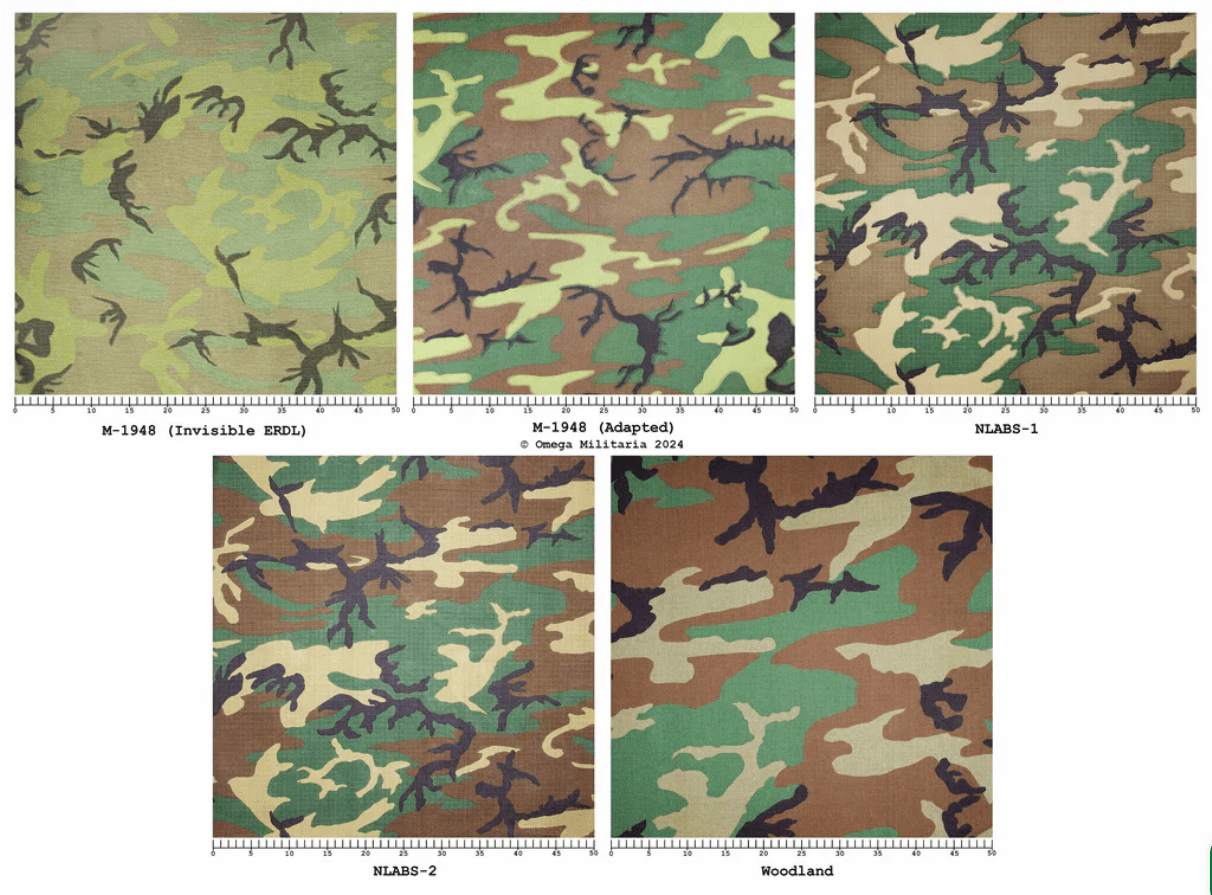
This article aims to serve as a guide to aid the reader in the proper identification of the four primarily used patterns, as well as some lesser-known variations and experimental patterns. It will include a visual identification guide and a detailed explanation of their development and history. Additionally, it will address common misconceptions, as well as highlight notable differences and similarities between the various patterns.
This article is a working document and will be updated when new information becomes available. It is best viewed on a desktop computer.
Four widely issued patterns can be commonly found on uniforms dating from the 1960s to the 2000s. The original M-1948 pattern was only used by the United States during trials but was later issued to Vietnamese forces. Throughout their service lives and beyond, servicemen and collectors have given each pattern several pseudonyms that can aid us in identification and discussion. Below is the official nomenclature used in government documents beside their respective ‘collectors’ terms.
– Ca. 1948: M-1948 – AKA: ‘Invisible ERDL’
– Ca. 1965: M-1948 (Adapted) – AKA: ‘Leaf’, ‘Lime Green Dominant’, ‘Lowland’, ‘Verdant’
– Ca. 1968: NLABS-1 – AKA: ‘Leaf’ ‘Brown Dominant’, ‘Highland’, ‘Delta’
– Ca. 1979: NLABS-2 – AKA: ‘Leaf’ ‘RDF’, ‘Transitional’
– Ca. 1981: Woodland – AKA: ‘M-81’, ‘BDU’

Initial Development
Circa 1948, Captain Adolph Henry Humphreys, Chief of Camouflage for the 1621st Reserve Training Unit (Research), United States Army Engineer Research & Development Laboratories (USAERDL) alongside John Hopkins and a team of engineers and artists developed a four-colour camouflage pattern for verdant terrain. [1]
This pattern, referred to as the “M-1948 Pattern”, “1948 Pattern”, “ERDL Pattern”, or simply, “4-Color Pattern” in government documents, was originally intended for use by U.S. forces in temperate climates. However, it was later adopted by the Vietnamese Army for use in the tropics of Southeast Asia and served as the foundation for a lineage of future camouflage designs used by U.S. troops in a broader spectrum of environments. It was composed of four colours, Yellow Green Army shade 354, Dark Green Army shade 355, Brown Army shade 356, and Black Army shade 357. [2]
Soon after the development of the M-1948 pattern, the concept of a general service camouflage uniform was shelved in favour of OG-107 which remained the uniform standard throughout the 1950s and 1960s.

Above: A group photograph including (then) Lt. Col. Adolph H. Humphreys (2nd to last, top row) alongside his peers at the Army Science Conference, 1966. [1]
Stateside Experiments
With rising boots-on-the-ground support by US advisors in Vietnam, the M-1948 pattern re-emerged during a controlled domestic test in 1962 titled ‘User Review of Camouflage For The Individual Combat Soldier In The Field’. The pattern was trialled alongside other camouflages and flat colours including; Marine Corps Mitchell Camouflage, OG-107, British Green and Khaki No.1. [3]
Despite performing favourably in some tests, the ERDL pattern was again disregarded as a potential general-service camouflage. This decision was primarily due to factors such as unsuitable environmental conditions and human biases. By the end of these trials, the results found camouflage patterns to be generally unfavourable compared to flat colours and OG-107 remained as the Army’s standard-issue uniform. [4]
“Unfortunately, extremely hot and dry weather seared the grass that comprised most of the viewing background and, therefore, the contrast with the terrain for these five uniforms was high” [4]
“As the test progressed, the observers became familiar with the test area. This may have biased the results.” [4]

Above: Four graphs showing the performance of ERDL (blue) against OG-107 (red) and USMC Mitchell camouflage – Note the overall lower detection rate of ERDL compared to OG-107 [3]

Above left: A photograph taken during the 1962 controlled camouflage tests shows men wearing the six camouflage patterns and flat colours that were tested (ERDL, 4th from left). [3]
Above right: A photograph taken during the 1962 controlled camouflage tests shows observers in booths overlooking the test area. Note the mostly flat, open terrain. [3]
In-Country Combat Trials
Later in the same year, The Advanced Research Projects Agency (ARPA) Field Unit introduced a concept for a reversible combat uniform designed for use by Vietnamese forces. It featured an M-1948 ERDL print on one side and a monotone black colour on the reverse. The black side was intended to disguise the wearer as a Vietnamese peasant farmer, whose common dress was often a black linen outfit.
The field tests were conducted for only four months between November 1962 and February 1963 by the ARVN’s 10th Ranger Battalion alongside a handful of US advisors. Limited to only 140 units, these uniforms were the first introduction of the ERDL pattern to a combat setting and validated the necessity of a camouflage uniform for Special Forces. [5]
The trials were ultimately deemed successful, leading to an order for an additional 450 uniforms in 1964 for further combat evaluation. These uniforms were locally produced, made from a lighter-weight fabric, and featured a similar cut. In March of that year, they were issued to special indigenous forces and one MACV-SOG unit for testing under actual combat conditions. [6]
The second rendition of the uniform was made with a 5 oz. poplin, similar to the fabric used for the Tropical Combat Uniform. They featured button-adjustable cuffs, two lower open patch pockets, and two button-secured chest pockets. [7]
These trials were also advantageous for the indigenous forces that participated in them. Beyond the trials, the Biệt Động Quân (BDQ / ARVN Rangers) and the ARVN Airborne Division adopted two versions of the ERDL pattern as their standard-issue uniforms. Firstly, rolls of surplus M-1948 (Invisible ERDL) fabric from the original stateside trials were shipped to Vietnam and fabricated into uniforms for indigenous forces. Secondly, a locally developed variation of the ERDL pattern, known as ‘BDQ ERDL,’ was produced and used for the domestic manufacture of uniforms.

Above left: An ARVN BDQ ERDL uniform set made with a 100% cotton sateen fabric. The shirt is faded, while the trousers are lightly worn. (Author’s collection)
Above right: A later pattern ARVN BDQ ERDL shirt made with a 100% cotton poplin fabric. Later models addressed the issue of fast-fading colours. (Author’s collection)
Following the initial in-country camouflage trials, in November 1965, the Tropical Combat Uniform Board was organised to discuss the prospects of adopting a standardised camouflage uniform. The proposition was again met with some resistance and the decision to retain OG-107 as a uniform standard remained. Despite positive feedback regarding concealment, the conclusion was made based on two overriding factors; firstly, identification of friendly troops wearing camouflage proved to be more difficult by low-flying aircraft, and secondly, individuals wearing camouflage patterns were more easily noticed when in motion due to pattern changes between the camouflage pattern and the environment. [8]
While USARV maintained the notion that camouflage patterns were not to be issued on a wide scale, as a result of the 1962-63 trials, the necessity for better concealment of special forces troops was realised. On the 10th of December, 1965, ‘United States Army, Vietnam’ (USARV) requested Natick Labs to send 300 ERDL camouflage Tropical Combat Uniforms (TCU) for field trials by reconnaissance platoons from the 173rd Airborne Brigade and 101st Airborne Division. The uniforms were delivered on the 23rd December, and were evaluated based on the following variables: concealment effectiveness, ability to withstand general wear, and resistance to fading and sun bleaching.
In 1966, the US Navy also conducted field trials with a Nomex flight suit printed with ERDL camouflage. 40 suits were issued to Marines of Marine Medium Helicopter Squadron 261 (HMM-261). [9]

Prior to the standardisation of ERDL, reconnaissance teams, Special Forces, and other special personnel acquired several kinds of camouflage uniforms by various means.
Above left: Two Jr. NCOs wear Beogam (left) and Tigerstripe (right) uniforms, both CISO-procured. Circa 1964-1965. (Photo courtesy of Paul W. Miraldi)
Above right: A US Advisor wears a privately-purchased commercial Kamo brand ‘Duck Hunter’ camouflage suit circa July 1962
Fielding
Following the success of ERDL in the 1962-1965 field trials, in February 1967, USARV filed an order for 18,373 uniforms for issue to pathfinders, LRRPs, and scout recon personnel in Vietnam. The Army approved the order in March 1967, and by June of that year, camouflage TCUs became the standard issue uniform for Special Forces-based and reconnaissance units, with their use restricted to these personnel only.
The Army Materiel Command received orders from USARV to expedite shipments of ERDL uniforms; however, the roll-out was slow, with the first deliveries made in December. [10]
Additionally, some units reported receiving only a fraction of the uniforms they had anticipated by the end of the year and most pathfinder and reconnaissance units were not issued the uniforms until 1968. [11]
All uniforms in this order were made from the same non-ripstop poplin fabric used for the OG-107 TCU. They were made in a ‘3rd Pattern’ cut with bellow cuffs and a back yoke.
Early batches of these uniforms contained two clearly definable variations of the adapted M-1948 pattern. The first variation, seen on most pre-production experimental models, featured sharp, defined shapes and a more subdued colour palette compared to the second type.
The second variation had slightly brighter, more saturated colours with feathered (blurred) edges. This feature is believed to have been an intentional printing method that ensured complete dye coverage, mitigating the effects of occasional roller slippage, which could cause blank spots and disrupt the efficacy of the camouflage. This feature was maintained throughout future production of the M-1948 and NLABS-1 patterns.

Above left: A slightly faded non-ripstop poplin coat from the 1967 order. It is printed with the earlier ‘hard-edge’ variant Adapted M-1948 pattern. (Author’s collection)
Above Centre: A SEAL Team 1 member wears a tropical combat coat printed with the earlier ‘hard-edge’ variant Adapted M-1948 pattern and a beret printed with the later ‘blurred-edge’ variant.
Above right: A second non-ripstop poplin coat from the 1967 order. It is printed with the later ‘blurred-edge’ variant Adapted M-1948 pattern. (Author’s collection)
Throughout the initial fielding of ERDL camouflage, the pattern continued to be studied, and Natick Labs continued work on improving it. Combat experience in Vietnam proved that the adapted M-1948 pattern was slightly too bright for the Vietnamese landscape. [12]
Additionally, results from the 1966 Navy trials indicated that the ERDL-printed flight suits provided improved camouflage in a green leafy environment, but in a predominantly brown environment, both ERDL and OG-107 suits contrasted sharply. [9]
Accordingly, an updated version of the pattern, known as NLABS-1 (Brown-Dominant ERDL), was introduced at some point between late 1967 and early 1968. This new iteration slightly muted the colour palette, and light brown shapes replaced the lime green ones from the previous design.
There is a misconception that NLABS-1 was developed for use in more mountainous, rocky, or muddy regions where the Adapted M-1948 pattern would be less effective. However, there is no known evidence to support this theory, and it is unlikely because providing two separate camouflage patterns for specific areas within the same theatre of operations would be logistically impractical.
A small quantity of non-ripstop poplin uniforms printed with the NLABS-1 pattern was produced under 1967 contacts. These uniforms were likely manufactured just prior to the advent of ripstop fabric. Subsequently, the vast majority of NLABS-1 uniforms were made under post-1967 contracts using ripstop fabric.

Some uniforms contained a mixture of M-1948 and NLABS-1 fabrics. For example, a coat may be comprised mostly of Brown-Dominant ERDL fabric with a few sporadic panels of Green-Dominant ERDL fabric. It is speculated that this was due to manufacturers using up old bolts of M-1948 fabric alongside newly produced NLABS-1 fabric. These types of uniform items are sometimes referred to by collectors as “Clown Camo” for their unusual appearance.
Left: A ripstop TCU coat with mismatched ERDL fabrics. The right arm, both breast pockets, and lower left pocket are made with adapted M-1948 ERDL fabric, while the rest of the jacket is made with NLABS-1 fabric. (Author’s collection)
Due to poorly defined colourist standards and loose printing tolerances, wartime ERDL patterns often suffered from colour inconsistencies and printing flaws that are sometimes mistaken for unique pattern types. Colours varied in shade and tone, and dyes were sometimes applied unevenly, causing noticeable imperfections. The introduction of the NLABS-2 pattern in 1979 addressed these errors, incorporating stricter standards and improved manufacturing processes to ensure greater consistency in colour and quality.

Above: A Tropical Combat Coat printed with NLABS-1 displays poorly printed black shapes, which appear speckled and overly faded. (Author’s collection)
By late 1968, the abundance of camouflage uniforms within Vietnam prompted the Marine Corps to adopt them as standard. Simultaneously, Navy Special Operations personnel began to utilise ERDL uniforms when they were able to acquire them. SEALs also began issuing an experimental floatation jacket (Commonly referred to as a “Float Coat”) printed with the adapted M-1948 and NLABS-1 patterns. Several regular Army units also began to issue ERDL uniforms as well; however, due to the gradual winding down of the War, the Army never had the opportunity to fully adopt the pattern as standard.

Above left: Marines of the 4th Marine Rgt., 3rd Marine Div. wear a mixture of adapted M-1948 & NLABS-1 uniforms circa 30th September 1969. (Photo by David Turnley)
Above right: A Navy SEAL wears an experimental ‘Floatation Coat’. Other ERDL uniform components are also worn. (Photo Credit: National Archives)
By the end of 1970, every branch of the US Military operating in Vietnam had begun distributing ERDL uniforms and other personal equipment to regular line infantry and other non-’special’ units. In the final five years of the conflict, ERDL started to supplant other colours and camouflage patterns on items such as helmet covers (USMC) and ponchos.

Above left: An ERDL lightweight poncho is used as a makeshift shelter. D co. 3rd Bn. 21st Inf. 196th Bde. US Army, circa 1971-1972. (Photo by Jim Comer)
Above right: Joseph F. Arata, a US Marine, wears an ERDL helmet cover circa 29th April 1975. (Photo by Stuart Herrington)
That is about half of an amazingly detailed history. As Hognose would say, go read the whole thing.
https://omegamilitaria.com/blogs/reference-guides/us-leaf-woodland-camouflage-patterns-1948-1981
 Scattered Shots
Australia always had its own cam patterns until recently, when it went to multicam.
Because of the terrain I hunt in I eventually settled on Kryptek Highlander. It’s fantastic stuff, and is like an invisibility cloak most of the time in my AO.
LikeLike