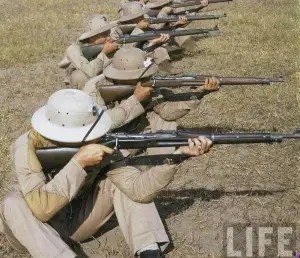
There are some US military fire arms that enjoy the love and adoration of millions of people. These guns earned a reputation from major battles and wars. Guns that entire generations used to fight off the enemies of America large and small. The M1 Garand, the M1911, the M1 Carbine. The M14… ahem.. One of those seems to have a lure and romance about it equal to or maybe beyond even the M1 Garand. That being the United States Rifle, Caliber .30-06, Model 1903. Also known as the “’03” or “Springfield”.
The story of the M1903 being adopted as the US service rifle is pretty well known to anyone who knows anything about it. The US was not happy with the very finely made and smooth action-ed side loading Krag rifle and its .30-40 service round after being shot to pieces by Spanish Mausers in the Spanish American War. Something about being under effective long range rifle fire from the other guy while you can not return same really drives a demand for change.
The Army got together all the experts, took a look at the captured Spanish Mausers and decided the US Army needed to be using comparable. In fact it was so comparable that a law suit was brought about over just how comparable the 03 was to the Mauser.
After a being adopted the M1903 had its share of problems. A number of Pre WW1 rifles had brittle metal and and the receivers would come apart in various uncomfortable ways while shooting. The problem was figured out and fixed eventually but it is not advised to risk shooting any “low number” M1903.

After getting this squared away the rifle then went on to glory and ever lasting fame in the hands of Doughboys like Sgt York ( maybe.. maybe not reports vary) and the USMC and its marksmanship skill. Official accounts of Marines mowing down Germans from long range with their rifles tell of great marksmanship with great rifles and images are every where os snipers using the 03 for the dawn of modern sniping. Though it was the standard service rifle it was not the most widely issued and used rifle by the troops. That was actually the M1917. But even though the 03 was still the rifle most coveted by the US troops. As said by Cpl. Mike Shelton: “What we really wanted were Springfields. They were the best rifles in the war”.
But were they?
The 1903 is a fine, fine rifle with beautiful lines. It handles like a dream compared to most of its peers and was accurate enough to be used to the US team int he Olympics. This makes for a beautiful military bolt action rifle.
It has a very finely adjustable precision rear sight and blade front sight. When folded down the rear sight is the open V notch and very small. When extended the rear sight has a tiny peep sight that is adjustable for windage and elevation. The adjustment was so fine it was capable of very precise adjustments. When using a sling while prone on a nice sunny day at Camp Perry a rifleman could show what the 1903 could achieve. The story of the Farr cup trophy and why it has that name is a great example of just what can be done with the sights of the standard M1903.

Those things are all that great , but not for the combat of WW1.

The rear sight in on the front of the receiver. Too far away for best most efficient use. Trying to look through the tiny rear aperture was useless in low light. And the light didn’t have to be all that low to make it impossible to use. The rain and mud of the trenches and battlefield could find its way into that peep. The front sight blade was too small and easily damaged. Low light also renders it difficult to see. The front sight was so easily damaged that a thicker blade was used by the USMC and a protective hood was used. This did protect the front sight but it also allows a little less light in. It also capture mud into the hood and front sight assembly. That being a common thing with all hooded front sights.
The rear sight’s fine precision adjustments are just that. Finely made with micrometer like precision. And slow. Very slow to use. The marksmanship of some units like the USMC was at a high enough standard that the rifleman could adjust their rear sight for outstanding long range precision fire on enemy infantry and machine gun positions. But this was not as often done as many make it seem. Adjusting the rear sight for precise long range fire on moving targets at undetermined distance while under rain and with mud covered hands as artillery fell around them made using the long range sights a daydream for most. The rear sight does have an open notch for faster firing and and closer range but it is small and not easy for anyone with less than perfect vision. This sight was set for 547 yd (500 m), and was not adjustable. Not very useful for ranges most likely encountered when time is critical . It also had the problem of not being well protected. Something the sights on a battle rifle need to be in such an unforgiving environment. Later on the M1903A3 rifle had a more simple peep sight on the rear of the action closer to the eye. The peep sight was better for most infantry engagements and was an improvement over the original.
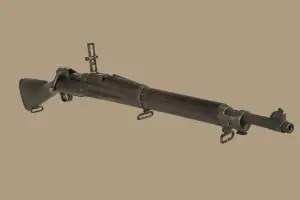
The M1903 had a typical for it’s day safety lever. It would be easy to complain about how slow it is to use if you need to fire quickly it was common. Other Bolt action combat rifles of the day had similar systems and a few had a fast and some what more natural feeling system .

One thing the military thought it needed was a magazine cut off. This little bit of brilliance was a lever that when activated would not allow the action to feed from the magazine. This would require you to load a single round by hand or flip it to allow magazine feed. The idea was you would fire and load one round at a time while keeping the internal magazine in reserve for when you really needed it and had no time to single feed by hand. This supposedly would save ammo. Either way it is always a dumb idea. It was dumb when it was on the Krag and it was dumb on the 1903. Especially since it could be unknowingly engaged.

None of of the things certainly deal killers or mentioned are deal killers or make the rifle useless by any means. The M1903 is a beautifully made gun and wonderfully accurate.
There is a reason for that old chestnut about service rifles from WW1. “The Germans brought a hunting rifle, the British brought a combat rifle and the US brought a target rifle.”
Now looking at the other option carried by US rifleman in WW1. The rifle at the time not as well admire but more widely issued and used. The M1917.

The M1917 was a rifle being made in the US for British troops in .303. When the US entered the war it did not have enough 1903s and there was no way to make enough in time. The decision was made to tweak the .303 rifle into using the .30.06 service round. This went off easily and the gun became the M1917 and was issued.
While it is heavier, it is built like a tank.

The magazine held one more round than the M1903. The safety was a lever on the right hand side. Much easier to quickly disengage.
The rear sight is positioned much closer to the eye and has a nice peep with a fold up sight for more precise longer range shooting. A great feature is the huge “ears” on each side that protects the rear sights from damage.

Another part of the M1917 that aids in fast action for combat is the action. Unlike the M1903 the M1917 cocks on closing. This may not seem like much of a difference but it is. In rapid fire it is much easier to work the bolt and cock it while rotating the bolt down with the speed and momentum of forcing the bolt forward then turning down opposed to cocking while lifting the bolt handle. The dog legged angled bolt handle is also very usable despite it’s oddball look. This allows for a very fast operation. It is also a feature of other British bolt action designs like the Lee Enfields. The MK 3 and MK 4s are very fast and smooth. British troops famously practiced rapid long range volley fire using their rifles and a technique of working the bolt and depressing the trigger with their bottom two fingers of the firing hand as soon as the bolt closed. A company of British troops firing in this manner could wreak a larger unit a long range and was an effective way to compensate for lack of machine gun support.
The M1917 has recently started to get the respect it deserves, it still does not have the admiration or mythical status of the M1903.
Luckily most of the things that make the M1903 less than idea for comabat were addressed in later models. AS I mentioned the M1903A3 corrected the rear sight issues with a peep sight that was simple to use and more suited for ranges most firefights really occur. It wasn’t made with the same aesthetic care and old world craftsmanship as the M1903 but it worked is really the better gun if you had to take one to war.
The M1903 served several roles in its career and is much respected. In some of those roles it was everything you could ask and more In others not so much. As a sniper rifle its target rifle accuracy , handling and trim lines really made it shine.

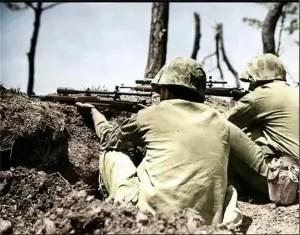
It served as a sniper rifle into WW2, Korea and even some in Vietnam. The Army opted for using a 4x weaver with the M1903A4 while the USMC adopted and used the Unertl 8x optic. A deadly combination that produced many Japanese widows. As seen below a team of USMC sniper on Okinawa.
Today the Springfield still enjoys a status as a real classic. A real icon of US military Arms. It’s accuracy being the stuff of legend and its full powered 30 caliber round will always be unquestioned in it’s ability. But, its original classic M1903 incarnation never saw nearly the amount of combat as many believe and it was certainly not the best bolt action of the war. It wasn’t even the best Mauser action combat rifle of the war.
Just like the M14, the original issued M1903 was. not much for fighting.
 Scattered Shots
The serial number range thought to contain the heat treating issue(s) is any Springfield S/N below 800,000 is to be tested or considered suspect. It should be explained that not all, and not even “most” of the rifles below 800K have faulty heat treatment.
Hatcher’s Notebook contains the details on this issue. What happened is that the guys in the heat treatment shop used to heat steel to a specific color as observed by eye. On sunny days, this could sometimes result in the steel being heated hotter than on cloudy days. Hatcher found that the difference could be as much as a 300F increase in pre-quench temps on a bright, sunny day.
The problem comes in when the steel is over-heated, trace elements added to the alloy of steel crystalize, and won’t re-form correctly when quenched. Alloy steel that is heated to excessive temperatures is effectively “burnt” and cannot be given remedial heat treatment, as can steels that aren’t heated hot enough. The steel that is over-heated becomes brittle and prone to sudden failure through fracture.
If you have or obtain a Springfield 1903 with a s/n under 800K, or a Rock Island under s/w 260K, you can take it to a heat treatment shop or metalurgy firm and get the hardness tested with non-destructive testing equipment.
The cure for this problem was to use proper instrumentation (pyrometers) to determine the temperature of receivers prior to quenching, rather than use the old “blacksmith’s eye” method of determining the temperature.
LikeLike