
After the invasion of Afghanistan in Autumn 2001 and especially after the invasion of Iraq in 2003, there was a great agitation in the DOD for the selection of a new pistol in a different caliber to replace the issue M9.
Early 2000s – Navy Special Warfare Command (NSW) worked with Heckler & Koch to develop a variant of the USP45CT. The initial hopes were to sneak its procurement under the radar as the Mk 23 Mod 1.
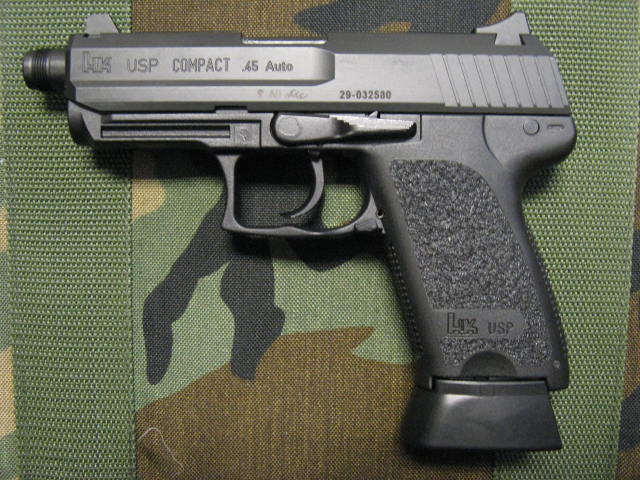

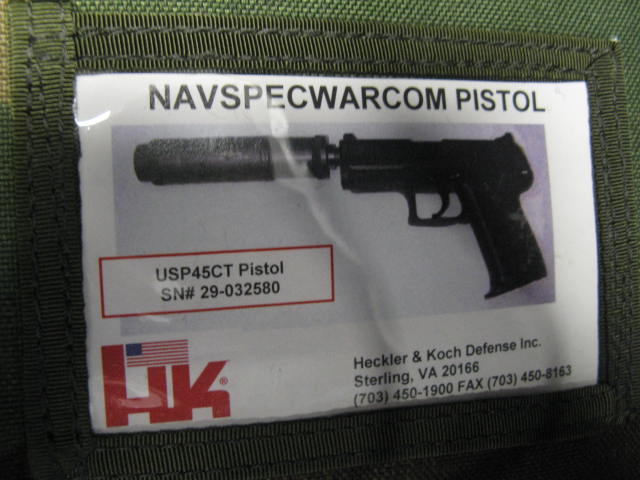
29 March 2004 – Multi-Caliber Capable Pistols (Sources Sought notice from SOCOM Headquarters Procurement Division on behalf of the Naval Special Warfare Development Group)
https://samdaily.us/archive/2004/03-March/31-Mar-2004/FBO-00556178.htm
1) Semi-automatic firing system;
2) Capable of firing either 9mm, 45 ACP, or .40 S&W;
3) Rail system integral to forward lower frame;
4) Magazine capacity 12 rounds for 45 ACP, 15 rounds for 9mm, 10 rounds for .40 S&W;
5) Weight not to exceed 40 ounces.
September 2004 – The US Coast Guard awarded a $4.2 million contract to SIG-Sauer for the P229 DAK in .40 S&W. The pistols were ordered off of an existing Department of Homeland Security (DHS) Immigration & Customs Enforcement (ICE) contract. The USCG began replacing their M9 with the P229 in October 2005.
1 October 2004 – Future Handgun System (Sources Sought notice from US Army ARDEC)
https://samdaily.us/archive/2004/10-October/03-Oct-2004/FBO-00687867.htm
The FHS will provide increases in terminal ballistic potential, durability, and reliability over the currently fielded M9/9x19mm and M11/9x19mm pistols. Specific features and characteristics of the FHS will include, but are not limited to, an integral accessory rail, enhanced day/night sighting capability, configurable grips (to suit the individual soldier’s need), and will permit the use of a sound suppressor when the threat/mission requires. The FHS will use munitions that are optimized for Army full-spectrum contingencies/applications. The FHS will also have a suitable, multi-configurable, holster(s) and ammunition carrier(s).
14 January 2005 – SOF Combat Pistol (Sources Sought notice from NSWC-Crane)
https://samdaily.us/archive/2005/01-January/16-Jan-2005/FBO-00735432.htm
3.1 SOF Combat Pistol System Definition. The Combat Pistol system shall include a caliber .45 pistol, 2 standard magazines, 4 high-capacity magazines, holster, cleaning kit, operator manual, and illuminator module (T). Available system accessories shall also include a threaded barrel for suppressor attachment, (T), suppressor (T), and a Laser Aiming Module (LAM) (O). The Combat Pistol should have a force-on-force training module that uses a non-lethal marking ammunition round that does not significantly or permanently injure operators when fired during force-on-force training (O).
3.2 Performance Requirements:
3.2.1 Reliability. The Combat Pistol shall have a Mean Rounds Between Stoppage (MRBS) of 2000 rounds (T) and 5000 rounds (O) firing A475, A483, and AA18 ammunition (T). The Combat Pistol shall have a MRBS of 500 rounds (T) 1000 rounds (O) with suppressor attached, firing A475, A483, and AA18 ammunition (T). The Combat Pistol shall have a Mean Rounds Between Failure (MRBF) of 5000 rounds (T) and 10,000 rounds (O) firing 95% A475 and A483 ammunition and 5% AA18 ammunition (T). The Combat Pistol shall have a Mean Rounds Between Failure (MRBF) of 1000 rounds (T), 2,000 rounds (O), with suppressor attached, firing 95% A475 and A483 ammunition and 5% AA18 ammunition (T). The weapon shall maintain the reliability standard when operated in extreme environments such as Over the Beach (OTB), jungle, and desert (sand and dust) (T).
3.2.2 Accuracy: The Combat Pistol when firing a 5-round group of A475 .45 ACP Ball ammunition shall be accurate to 4.5-inch extreme spread at a range of 25 meters fired from a machine rest (T), less than 4.5-inch extreme spread at a range of 25 meters (O). Accuracy requirement shall be met unsuppressed and suppressed (T). Point of impact shift unsuppressed to suppressed shall be consistent and shall be 3 inches or less at 25m (T).
3.2.3 Service Life. The Combat Pistol shall have a service life of 20,000 rounds, (T) greater than 20,000 rounds (O) using A475 .45 ACP Ball and A483 .45 ACP match ammunition (T). The Combat Pistol should be capable of maintaining these service life goals when firing 5% AA18 .45 +P ammunition (O). The firing schedule will be as follows: The weapons will be fired 125 rounds of A475 or A483, then the suppressor will be installed and the weapon fired with 25 rounds of AA18, then fired 100 rounds of A475 or A483. The weapon will be cooled and suppressor removed. Then it will be fired another 250 rounds of A475 or A483. The weapon will be cooled and cleaned per manufacturer’s instructions. The rate of fire for this cycle will be 10-30 rounds per minute. The cycle will be continued until the usable service life of the pistol is determined, or the round count of 20,000 rounds is reached, whichever comes first. If the weapon reaches the 20,000 round thresholds, the weapon, at the Navy’s decision, may be tested further to attain its actual service life. During cycles, test data sheets will be used to record rounds, failures, parts replacement, stoppages, and cleaning schedule. The weapons will be visually inspected at every cleaning cycle. The receiver, barrel, slide, etc… will be Magnetic Particle Inspected using NDI methods every 5000 rounds to check for metal fatigue.
3.3 Physical description:
3.3.1 Weight. The Combat Pistol without magazine or attached accessories shall weigh less than 39 ounces (T), 26 ounces (O).
3.3.2 Length: The Combat Pistol length with standard barrel shall be less than 8.75 inches (T) less than 7.5 inches (O) measured along the axis of the bore.
3.3.3 Width: The Combat Pistol width shall be less than 1.5 inches (T), 1.28 inches (O).
3.3.4 Height: The Combat Pistol height shall be less than 5.5 inches (T) 5.3 inches (O).
3.3.5 Magazine Capacity. The Combat Pistol shall have a standard magazine capacity of no less than 8 rounds (T), greater than 8 rounds (O) of .45 ACP ammunition. The Combat Pistol shall also have a high-capacity magazine of no less than 10 rounds that will not create a snag hazard when inserted in the magazine well (T).
3.3.6 Accessory Rail: The Combat Pistol shall have an integral MIL-STD-1913 rail(s) for the attachment of accessories. (T) The rail shall be located forward of the trigger guard on the lower portion of the frame. (T)
3.3.7 Surface Finish. The Combat Pistol surface finish shall be non-reflective, resistant to peeling, flaking, and chipping, and require a minimum of operator preventive maintenance (T). Internal coatings should be lubricious/low friction mitigating the use of lubricants (O). Non-metallic components shall be fungus and battlefield chemical resistant (T).
3.3.8 Color: The Combat Pistol and accessories shall be delivered in Color #30118 (Flat, Dark Earth), per FED-STD-595B (O).
12 May 2005 – The USMC issues a sole-source solicitation to Beretta for the M9A1 with integral accessory rail.
https://www.fbodaily.com/archive/2005/05-May/12-May-2005/FBO-00804240.htm
10 June 2005 – The USMC orders 3,480 M9A1 pistols.
26 August 2005 – Joint Combat Pistol (Pre-Solicitation notice from SOCOM Headquarters Procurement Division – Merges Future Handgun System with SOF Combat Pistol)
https://samdaily.us/archive/2005/08-August/28-Aug-2005/FBO-00881015.htm
The Combat Pistol System consists of: a Caliber .45 pistol and its ancillary equipment including: Magazines (standard and high-capacity); Suppressor Attachment Kit for operation of the pistol with and without sound suppressor; Holster; Magazine Holder (standard and high-capacity); Cleaning Kit; and Operator’s Manual. The contract type will be an Indefinite Delivery/Indefinite Quantity (IDIQ) issuing Firm-Fixed Price (FFP) delivery orders. The contract period of performance shall be Five (5) years with an option to extend for an additional Five (5) years. The Minimum Quantity is 24 each Engineering Test Units (ETU’s), 12 each with external manual safety and 12 each without external manual safety. The estimated Maximum quantities are: 45,000 no external safety JCP configuration and 600,000 JCP with the external safety configuration; 649,000 Holsters; 96,050 Standard Capacity Magazines; 192,099 High Capacity Magazines; 667,000 Magazine Holders; 132,037 Suppressor attachment kits; Provisioning Item Order, Technical Data Package and associated Data.
3.1 JCP Definition. The JCP System shall include:
3.1.1 Weapon. A caliber .45 pistol, two [2] standard-capacity magazines, operator’s manual, and cleaning kit.
3.1.2 Holster.
3.1.3 High Capacity Magazine. Four [4] high-capacity magazines.
3.1.4 Magazine Holder.
3.2 Performance Requirements:
3.2.1 Reliability. The JCP shall have a Mean Rounds Between Stoppage (MRBS) of 2000 rounds (T) and 5000 rounds (O) firing A475 and A483 ammunition. The JCP shall have a Mean Rounds Between Failure (MRBF) of 5000 rounds (T) and 10,000 rounds (O) firing A475 and A483 ammunition. The weapon shall function reliably when operated in extreme environments per section 3.6.
3.2.2 Accuracy. When fired from a rest, at a range of 50 meters, the mean radius of a 10-shot group fired from the JCP shall not be greater than A) 3.15 inches or B)1.8 inches over baseline ammunition performance, whichever is less (T). Baseline ammunition performance is defined as the average mean radius plus two sample standard deviations of three 10-shot groups fired from a test barrel at 50m.
3.2.3 Service Life. The JCP shall have a service life of 20,000 rounds (T), greater than 20,000 (O), using A475 .45 ACP Ball, and/or A483 .45 ACP match ammunition. The JCP should be capable of a service life of 20,000 rounds when firing 5% AA18 .45 +P ammunition (O). Receiver service life shall be defined as a receiver that is at the end of its usable life cycle.
3.3 Physical description.
3.3.1 Magazine Capacity. The JCP shall have a standard magazine capacity of no less than eight [8] rounds (T), greater than eight [8] rounds (O) of .45 ACP ammunition. The JCP shall also have a high-capacity magazine of no less than ten [10] rounds (T), fifteen [15] rounds (O), of .45 ACP ammunition.
3.3.2 Pistol Lanyard Attachment Point. The JCP shall have a rigid attachment point for a lanyard (T). The JCP lanyard attachment point shall not interfere with the JCP control features or magazine unloading and reloading, and shall minimize snag hazard (T).
3.3.3 Accessory Rail. The JCP shall have an integral MIL-STD-1913 rail for the attachment of accessories (T). The rail shall be located forward of the trigger guard on the lower portion of the frame (T).
3.3.4 Surface Finish. The JCP surface finish shall be non-reflective, resistant to peeling, flaking, and chipping, and require a minimum of operator preventive maintenance (T). Internal coatings should be lubricious/low friction mitigating the use of lubricants (O). Non-metallic components shall be fungus and battlefield chemical resistant (T). JCP materials and coatings shall protect the pistol from degradation in all climates and geographical areas including maritime, coastal, desert, tropical jungle, arctic, urban areas, and mountain environments (T). The materials and coatings shall minimize the attraction of dust and contamination (T).
3.3.5 Color. The JCP frame and JCP holster shall be delivered in Color #30118 (Flat, Dark Earth), Per FED-STD-595B (T). The barrel and slide shall be anti-reflective, matte grey or matte black finish comparable to FED-STD-595B series #36000 or #37000 colors (T).
3.3.6 Length. The JCP length, with standard barrel, shall be less than 9.65 inches (T).
3.3.7 Width. The JCP width shall be less than 1.53 inches (T).
March 10, 2006 – Combat Pistol (Modification notice from SOCOM Headquarters Procurement Division – The US Army drops out of joint procurement)
https://samdaily.us/archive/2006/03-March/12-Mar-2006/FBO-01004554.htm
The Combat Pistol System consists of: a Caliber .45 pistol and its ancillary equipment including: Magazines (standard and high-capacity); Suppressor Attachment Kit for operation of the pistol with and without sound suppressor; Holster; Magazine Holder (standard and high-capacity); Cleaning Kit; and Operator’s Manual. The contract type will be an Indefinite Delivery/Indefinite Quantity (IDIQ) issuing Firm-Fixed Price (FFP) delivery orders. The contract period of performance shall be five (5) years with an option to extend for an additional five (5) years. The Minimum Quantity is 24/ea Engineering Test Units (ETU’s). The estimated maximum quantities are: 50,000/ea combat pistol systems (which includes a .45 caliber CP, 2 standard capacity magazines, operator’s manual and cleaning kit); 50,000/ea Holsters; 200,000/ea Standard Capacity Magazines; 360,000/ea High Capacity Magazines; 50,000/ea Magazine Holders; 15,000/ea Suppressor attachment kits; Provisioning Item Order; associated data; and 3/ea Instructor and Key Personnel (I&KP) Training courses.
May 2006 – The USMC modifies its 2005 solicitation for additional Beretta M9A1, increasing the order by 4,020 pistols.
https://www.fbodaily.com/archive/2006/05-May/19-May-2006/FBO-01050230.htm
5 September 2006 – Combat Pistol (Modification notice from SOCOM Headquarters Procurement Division – SOCOM drops the Combat Pistol solicitation)
https://samdaily.us/archive/2006/09-September/08-Sep-2006/FBO-01135668.htm
31 October 2006 – Air Force Handgun (Sources Sought notice from Air Force Materiel Command)
https://samdaily.us/archive/2006/11-November/02-Nov-2006/FBO-01173583.htm
.45 ACP
16 April 2007 – Air Force Future Handgun (Sources Sought notice from Air Force Materiel Command)
https://samdaily.us/archive/2007/04-April/18-Apr-2007/FBO-01274260.htm
.45 ACP
28 April 2008 – Modular Handgun System (Sources Sought notice from US Army TACOM Life Cycle Management Command – Rock Island. Note that this was actually issued on behalf of the USAF.)
https://samdaily.us/archive/2008/04-April/30-Apr-2008/FBO-01562302.htm
USAF requirement is ~ 100,600 pistols and associated ammunition.
System Performance.
• System Accuracy. Accuracy will be assessed by two measures:a) To a range of 50 meters, when the weapon is mounted in a machine rest or manufacturer’s design rest with a human shooter, dispersion will be no greater than a 4” Circular Error of Probability (CEP).
b) When in the hands of a shooter, the weapon must enable the shooter to successfully engage E-type silhouettes and:
1) Hit each target with 2 shots to the upper torso and one to the head within 7 – 10 seconds at 15 meters.
2) Hit the target with 2 shots at 7 meters within 4 seconds.
• Projectile characteristics. The Handgun System should enable the shooter to produce a wound channel larger than an M882 projectile when firing standard ball (FMJ, non-expanding) ammunition into ballistic gelatin from a distance of up to 25 meters where the cavity is measured from 0-14 inches deep.
• Reliability. The Modular Handgun System shall demonstrate 2,000 Mean Rounds Between Stoppage (MRBS) (operator clearable/correctable stoppages), and 5000 Mean Rounds Between Failures (MRBF) (nonoperator correctable).
• Service Life. The Modular Handgun shall have a minimum service life of 25,000 rounds.System Characteristics.
• Ergonomics. The Modular Handgun System must accommodate the 5th to 95th percentile of users. Determination will be made based on width, length, grip circumference, location of controls, ambidextrous controls, etc.
• Target Acquisition Enablers. As a minimum, Mil-Std-1913 rails shall be incorporated on the weapon to enable rail mounted accessories to be attached. Integrated aiming /pointed devices are of interest and will also be evaluated.
• Physical Dimensions: With sights attached and empty magazine inserted in weapon, the following dimensions are not to be exceeded:a) The full size version shall be no more than 8.7 inches long, 5.8 inches high, and 1.6 inches wide. Weight shall not exceed 36 ounces.
b) The compact version shall be no larger than 7.5 inches long, 5.8 high, and 1.6 inches wide. Weight shall not exceed 34.5 ounces.
• Detection Avoidance: Weapon shall be of a non-reflective neutral color. The MHS shall be operable with sound and flash suppression kit in place.
• Safety Mechanisms: As a minimum, the handgun shall have internal safety mechanisms in place such that a loaded cartridge will not fire if the weapon is dropped from a height of 5 feet onto a concrete or other hard surface. The weapon shall also have an external, manually operated safety button/switch operable with one hand.
Fiscal Year 2009 – USASOC adopts the Glock 19 as the “Combat Assault Pistol.” The pistol is justified on the excuse that it is smaller and more concealable than the M9.
Fiscal Year 2010 – USASOC adopts the Glock 26 as the “Concealed Carry Pistol.”
2010 – To begin filling their Family of Low Visibility Concealable Pistols (LVCP) requirement, SOCOM acquires 2,500 Glock 19 from the Department of Homeland Security (DHS).
12 January 2010 – NSW adopts the HK45CT as the “Combat Assault Pistol.” This ultimately receives the official designation Mk 24 Mod 0. (N00164-10-D-JN24)
19 May 2011 – NSW awards its first contract for the Mk 25 Mod 0 variant of the SIG-Sauer P226. (N00164-11-D-JN98)
8 January 2013 – Modular Handgun System (Sources Sought notice from Army Contracting Command – New Jersey)
https://samdaily.us/archive/2013/01-January/10-Jan-2013/FBO-02960851.htm
1. Performance Improvement: Request information on potential improvements in handgun performance in the areas of accuracy and dispersion out to 50m, terminal performance, modularity, reliability and durability in all environments.
* The handgun and ammunition combination should, at a range of 50 meters, have a 90% or better probability of hit on a 4 inch circle when fired from a test fixture. It must maintain this throughout the life of the system. Systems are encouraged to utilize ergonomic and design improvements to minimize the effects of greater recoil energies, reducing the degradation of shooter-in-the-loop dispersion thereby improving the probability of hit.
* Modularity includes but is not limited to compatibility with accessory items to include tactical lights, lasers and sound suppressors. There is specific interest in designs that would be adaptable and/or adjustable to provide enhanced ergonomics that ensure 5th percentile female through 95th percentile male military personnel access to controls, such as the safety, magazine release, slide release and all other applicable controls. There is also interest in designs that offer these enhanced ergonomics while providing full ambidextrous controls.
* The handgun ammunition’s terminal ballistics will be evaluated at ranges of 0-50m, over 0-14 inches of ballistic gelatin, to determine whether it provides more lethality when compared to the current U.S. Military M882 ammunition fired from the M9. Ammunition evaluated will meet international law of war conventions that bound current general purpose military ammunition. The Pistol evaluated must be capable of chamber pressures equal to or greater than SAAMI specification for the given cartridge, with prolonged reliability equal to or greater than the current M9. However, the ability to accommodate higher chamber pressures in excess of 20% over SAAMI spec without degradation of reliability is of specific interest.
* Reliability and Durability includes but is not limited to Mean Rounds between Stoppage (MRBS), Mean Rounds Between Failure (MRBF) and Service Life. There is specific interest in designs with ratings of at least 2,000 rounds MRBS, 10,000 rounds MRBF and 35,000 round Service Life.
2. Production capacity estimates. Request information on minimum and maximum monthly production rates for a military handgun and associated ammunition as well as the lead times to achieve these production rates. This estimate should consider a US based production facility by the third year of deliveries. This capacity should be above and beyond any current production orders or current sales. If new facilities are planned or required, so state. A list of State and Federal agencies, as well as foreign governments, that have adopted the handgun should also be included.
5. Rough Order of Magnitude (ROM) Estimate. Request estimated pricing for the submission based on the following quantities: 250,000 to 550,000 handguns.
11 March 2013 – Modular Handgun System (Modification notice)
https://samdaily.us/archive/2013/03-March/13-Mar-2013/FBO-03008388.htm
October 2013 – The US Army adopts in full the US Air Force’s CPD for the Modular Handgun System.
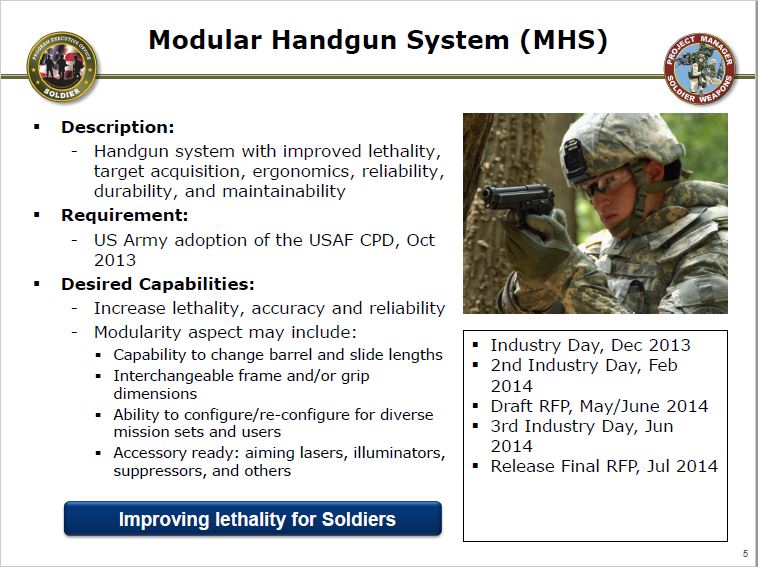
7 November 2013 – Modular Handgun System (Special Notice – Announcement for MHS Industry Day)
https://samdaily.us/archive/2013/11-November/09-Nov-2013/FBO-03230164.htm
3 December 2013 – Modular Handgun System (Addendum to the announcement for MHS Industry Day)
https://samdaily.us/archive/2013/12-December/05-Dec-2013/FBO-03244373.htm
10 December 2013 – Modular Handgun System (Addendum to the announcement for MHS Industry Day)
https://samdaily.us/archive/2013/12-December/12-Dec-2013/FBO-03249147.htm
10 February 2014 – Modular Handgun System (Questions and Answers from Industry Day #1)
https://samdaily.us/archive/2014/02-February/12-Feb-2014/FBO-03284954.htm
12 February 2014 – Modular Handgun System (Special Notice – Announcement for MHS Industry Day #2)
https://samdaily.us/archive/2014/02-February/14-Feb-2014/FBO-03287839.htm
27 February 2014 – Modular Handgun System (Special Notice – MHS Industry Day #2 postponed)
https://samdaily.us/archive/2014/03-March/01-Mar-2014/FBO-03298395.htm
10 June 2014 – Modular Handgun System (Request for Information)
https://samdaily.us/archive/2014/06-June/12-Jun-2014/FBO-03391276.htm
18 June 2014 – Modular Handgun System (Special Notice – MHS Industry Day #2 rescheduled)
https://samdaily.us/archive/2014/06-June/20-Jun-2014/FBO-03399726.htm
https://samdaily.us/archive/2014/06-June/20-Jun-2014/FBO-03399727.htm
9 September 2014 – Modular Handgun System (Questions and Answers from Industry Day #2)
https://samdaily.us/archive/2014/09-September/12-Sep-2014/FBO-03504659.htm
18 September 2014 – Modular Handgun System (Special Notice – Announcement for MHS Industry Day #3)
https://samdaily.us/archive/2014/09-September/20-Sep-2014/FBO-03518454.htm
25 September 2014 – Modular Handgun System (Special Notice – MHS solicitation number updated)
https://samdaily.us/archive/2014/09-September/27-Sep-2014/FBO-03529171.htm
29 September 2014 – Modular Handgun System (Special Notice – Draft Request for Proposal)
https://samdaily.us/archive/2014/10-October/01-Oct-2014/FBO-03536451.htm
https://samdaily.us/archive/2014/10-October/01-Oct-2014/FBO-03536452.htm
https://samdaily.us/archive/2014/10-October/01-Oct-2014/FBO-03536526.htm
23 October 2014 – Modular Handgun System (Special Notice – Read Ahead Questions to participants for MHS Industry Day #3)
https://samdaily.us/archive/2014/10-October/25-Oct-2014/FBO-03557184.htm
24 October 2014 – Modular Handgun System (Follow-up Questions and Answers from Industry Day #2)
https://samdaily.us/archive/2014/10-October/26-Oct-2014/FBO-03557975.htm
7 November 2014 – Modular Handgun System (Special Notice – Solicitation Response Time)
https://samdaily.us/archive/2014/11-November/09-Nov-2014/FBO-03569552.htm
December 2014 – Beretta submits an unsolicited Engineering Change Proposal for the M9A3. The ECP is rejected by the Army.
21 January 2015 – Modular Handgun System (Special Notice – Release of the Request for Proposal delayed)
https://samdaily.us/archive/2015/01-January/23-Jan-2015/FBO-03621263.htm
30 January 2015 – Modular Handgun System (Questions and Answers from Industry Day #3)
https://samdaily.us/archive/2015/02-February/01-Feb-2015/FBO-03629843.htm
1 April 2015 – Modular Handgun System (Additional Questions and Answers from Industry Day #3)
https://samdaily.us/archive/2015/04-April/03-Apr-2015/FBO-03686706.htm
5 June 2015 – Modular Handgun System (Special Notice – Announcement for MHS Industry Day #4)
https://samdaily.us/archive/2015/06-June/07-Jun-2015/FBO-03755061.htm
8 June 2015 – Modular Handgun System (Special Notice – Draft Request for Proposal #2)
https://samdaily.us/archive/2015/06-June/10-Jun-2015/FBO-03756790.htm
https://samdaily.us/archive/2015/06-June/10-Jun-2015/FBO-03756791.htm
14 July 2015 – XM17 Modular Handgun System (Pre-Solicitation notice)
https://samdaily.us/archive/2015/07-July/16-Jul-2015/FBO-03796996.htm
28 August 2015 – XM17 Modular Handgun System (Request For Proposal issued)
https://samdaily.us/archive/2015/08-August/30-Aug-2015/FBO-03861376.htm
(The RFP for the XM17 can be a little confusing as its sections are out of order with the timeline of events. Section L covers the initial submission of pistol candidates, and Section M covers the factors behind the downselect to the last three candidates. However, you then have to hop to Section H to see the award factors for the final winner. Section C then covers the selected XM17 winner’s Production Verification Testing (PVT) and entry to production status.)
Maximum Quantities
————————————————————-
| Item Description | Quantity
————————————————————-
| HANDGUN:
————————————————————-
| MHS Production | 550,000
————————————————————-
| Weapon System Component Package – COMPACT | 2
————————————————————-
| COMPACT MHS – First Article Test (FAT) | 1
————————————————————-
| Demonstration Models | 360
————————————————————-
| Cutaway Models | 360
————————————————————-
| MHS Blank Conversion Kit FAT | 2
————————————————————-
| MHS Blank Conversion Kit | 193,500
————————————————————-
| MHS 1041 Cartridge Conversion Kit FAT | 2
————————————————————-
| MHS 1041 Cartridge Conversion Kit | 193,500
————————————————————-
| MHS Suppressor Kit FAT | 2
————————————————————-
| MHS Suppressor Kit | 193,500
————————————————————-
| MHS General Officer Pistol | 9,000
————————————————————-
————————————————————-
| AMMUNITION:
————————————————————-
| XM1152 Ball Cartridge FAT | 1
————————————————————-
| XM1152 Ball Cartridge | 80,000,000
————————————————————-
| XM1153 Special Purpose Cartridge FAT | 1
————————————————————-
| XM1153 Special Purpose Cartridge | 20,000,000
————————————————————-
| DDI Cartridge-First Article Test (FAT) | 1
————————————————————-
| DDI Cartridge-Production | 40,000
————————————————————-
| BLANK Cartridge-First Article Test (FAT) | 1
————————————————————-
| BLANK Cartridge-Production | 60,000
————————————————————-
| XM1152 BALL Cartridge-Demonstration Model | 80
————————————————————-
| XM1152 BALL Cartridge-Cutaway Model | 80
————————————————————-
| XM1153 SP Cartridge-Demonstration Model | 80
————————————————————-
| XM1153 SP Cartridge-Cutaway Model | 80
————————————————————-
| EPVAT Barrels | 60
————————————————————-
| Accuracy Barrels XM1152 BALL Cartridge | 60
————————————————————-
| Accuracy Barrels XM1153 SP Cartridge | 60
————————————————————-
| Profile-Alignment Gage-XM1152 Ball Cartridge | 200
————————————————————-
| Profile-Alignment Gage-XM1153 SP Cartridge | 200
————————————————————-
| Spare Parts | 27,500
————————————————————-
The MHS procurement is intended to be an open caliber competition, which means the choice of caliber is left to the discretion of the Offeror. Offerors are permitted to submit up to two (2) proposals configured to the specific caliber it chooses for evaluation. If an Offeror chooses to submit two (2) proposals, their submissions must each be chambered in a different cartridge of the Offeror’s choosing. In addition, each proposal must be submitted independently from each other.
Each proposal will consist of either a two (2) handgun solution (one full size and one compact), or one (1) handgun solution that meets requirements for both a full size and compact weapon, plus the following ammunition: ball, special purpose, and dummy drilled inert (DDI), as well as, accessories (to include spare parts).
Each Offeror will be required to conduct a Contractor Product Instruction/Training Demonstration session to the Government on the hardware and the manuals. The Government will schedule times and dates to conduct the Contractor Product Instruction/Training Demonstration.
The Government intends to award up to three (3) Firm Fixed Price (FFP), Indefinite Delivery/Indefinite Quantity (IDIQ) contracts based on the results of the initial evaluation of the proposal submission by following the evaluation procedure contained in section M of this RFP. The Government will then make a final down-selection to a single contractor by following the evaluation procedures contained in section H of this RFP. The period of performance of the base contract(s) will be ten (10) years for the handgun, accessories and spares and five (5) years for the ammunition.
Each contract that is awarded will be issued a delivery order in the base year to meet the minimum guarantee for the contract. The minimum contract guarantee will consist of the weapon system component package (CLIN 0001), as described in the statement of work. The weapon system component package items, which will be due 60 days from receipt of order will be used as part of the down-select evaluation as described in section H of this RFP. The Contractors not selected to provide production units, as a result of the downselect evaluation will have their contracts considered complete with no further obligation required by the Government. All bid sample hardware received from unsuccessful Offerors, with the exception of ammunition, will be returned in an as tested condition. These items will be returned to the respective Offeror per the same address from which it was received.
SECTION L – INSTRUCTIONS, CONDITIONS, AND NOTICES TO OFFERORS
L.1 PROPOSAL SUBMISSION
L.1.5 Bid Sample and Hardware Submission
Sample hardware shall be representative of the Offerors production processes and quality that can be expected in full rate production units. Offerors hardware submission shall be verified for completeness. If it is determined that a part of the submission is missing the Offeror shall be notified and be given no more than 10 business days to complete the submission. Failure to submit within 10 business days will result in elimination from the competition.
NOTE: UID labels shall be applied to the serialized component of the handgun.
Interested Offerors must submit thirty-two (32) complete, identical, and functional bid samples of their proposed full size Modular Handgun System, and four (4) compact Modular Handgun System (if applicable). Each bid sample shall consist of the following:
L.1.5.1. Handgun: Each Offeror shall provide Modular Handgun System candidate systems (both full size and compact) in accordance with the Modular Handgun System Purchase Description (AR-PD-177). Interested Offerors must submit thirty-two (32) complete, identical, and functional bid samples of their proposed full size Modular Handgun System , and four (4) compact Modular Handgun System (if applicable). If the Offeror is submitting a one (1) gun solution, thirty-six (36) complete, identical, and functional bid samples are required. Single gun proposals will be evaluated against the requirements of both the full size and compact weapons. Standard commercial markings are acceptable for bid samples.
L.1.5.2. Removable Magazines: Each Offeror shall provide three (3) removable ammunition magazines per handgun to meet the following requirements. Full size pistols require two (2) Full Size Extended Capacity magazines and one (1) Full Size Standard Capacity. Compact pistols require one (1) Compact Standard Capacity magazine and two (2) standard magazines (as used in the full size handgun). If a single gun solution is proposed, two (2) Full Size Extended Capacity magazines and one (1) Full Size Standard Capacity magazine will be required to be submitted. The total number of magazines required for Bid Sample Testing should be: 200 extended magazines, 220 standard magazines (which includes 120 for the compact) and 60 compact magazines. The magazines shall allow for disassembly without the use of special tools, and shall not require any special tools to load. The term special tool is defined as a unique and/or new tool/device needed by the Soldier for the handguns routine operator-level maintenance, cleaning, and field stripping. For additional information on the magazine requirement, reference the Modular Handgun System Purchase Description (AR-PD-177) Paragraph 3.4.7.
L.1.5.3. Holster: Each Offeror shall provide thirty (30) right handed and ten (10) left handed sleeves that are compatible with the Improved Modular Tactical Holster (IMTH) Quick Disconnect (female adapter), PN 430952CT.
L.1.5.4 Magazine Pouches: Each Offeror shall provide eighty (80) MOLLE compatible magazine pouches. Each magazine pouch shall securely carry 1 extended magazine, in accordance with TM-10-8465-236-10. The magazine pouches shall have a cover to protect the magazine from environmental conditions, such as sand, dust, mud, etc. The magazine pouch shall have a drain hole. The magazine pouch shall be similar in form, fit and function as the currently issued magazine pouches listed here: NSN 8465-01-524-7361 (Digital ACU) or 8415-01-519-6467 (Olive Drab) or 8415-01-519-5184 (Khaki).
L.1.5.5. Cleaning Kit: Each Offeror shall provide one (1) bore brush per handgun. The bore brush for the handgun shall be compatible with the currently issued cleaning rod: Rod, Cleaning, Cal .45, M4 Drawing number 5564102. A drawing for the currently issued cleaning brush tip is included for reference: Tip, Cleaning Brush Drawing number 5238602. These drawings are included as attachments.
L.1.5.6. Replacement Barrels and Spare and Repair Parts: Each Offeror shall provide replacement barrels, spare and repair parts, magazines, and spare supplies for the cleaning kits adequate to support the evaluation.
NOTE: A sufficient number of replacement barrels, magazines, spare and repair parts as determined by the Offeror, is required to support the following tests. Note that the quantities of ammunition below is a subset of the total quantities required as listed in paragraph L.1.5.11.
—————————————————————–
|Test |Number of Guns |Rounds per Gun |Total Rounds |
—————————————————————–
|Reliability | 3 | 12,500 | 37,500 |
—————————————————————–
|High Temperature | 3 | 3,600 | 10,800 |
—————————————————————–
|User Evaluation | 10 | 1,000 | 10,000 |
—————————————————————–
ALL HANDGUNS PROVIDED AS PART OF THE PROPOSAL SUBMISSION WILL BE USED IN TESTING. The results of High Temperature testing will be used to support the issuance of a safety release. This test will be conducted as outlined in paragraph 4.7.10.2 of purchase description AR-PD 177. Any weapon that fails to have a safety release issued, will be eliminated from further consideration.
L.1.5.7. …
The Modular Handgun System will be subject to exposure to dye penetrant chemicals during Non Destructive Testing (NDT). Non-Destructive Testing will be performed upon initial inspection, at intervals of 4,000 rounds, and at final inspection. Sufficient spares and mandatory replacement parts (i.e.: roll pins, screws, etc) are to be provided to facilitate disassembly/ reassembly throughout the bid sample testing.
Any special tools required to support the Modular Handgun System during the live fire tests shall be supplied by the Offeror. Offerors will not be given the opportunity to provide additional spare and repair parts while testing is being conducted; therefore, all replacement barrels, magazines and spare and repair parts must be provided at the date/time of proposal submission, prior to initiation of testing. There is NO LIMIT to the number of spares that an Offeror can provide nor will an Offeror be negatively rated for providing extra spares. ANY CANDIDATE SYSTEM THAT DOES NOT MEET TEST REQUIREMENTS DUE TO PARTS BREAKAGE AND A LACK OF SPARE AND REPAIR PARTS WILL BE CONSIDERED NON-OPERATOR REPAIRABLE AND WILL BE DOCUMENTED AS A CLASS III FAILURE REGARDLESS OF THE TYPE OF FAILURE. ADDITIONALLY, ANY MODULAR HANDGUN SYSTEM CANDIDATE WHO RECEIVES A CLASS III FAILURE FOR INSUFFICIENT SPARES, WHICH INCLUDES MAGAZINES OR REPLACEMENT BARRELS WILL BE RATED AS UNACCEPTABLE AND WILL BE ELIMINATED FROM FURTHER CONSIDERATION FOR CONTRACT AWARD. Failure definitions can be obtained from Section 4.8.1.3 and 6.7 of the Modular Handgun System Purchase Description (AR-PD-177).
L.1.5.8. Ransom Rest Inserts: Each Offeror shall provide two (2) Ransom Rest inserts for use with their full size candidate modular handgun systems. In addition, each Offeror will specify the torque to which the insert fasteners will be tightened for use in accuracy testing. Torque specifications shall be included with the Ransom Rest inserts. Specifications shall be provided in such a manner as to ensure the instructions are not lost during delivery to the Aberdeen Test Center.
L.1.5.9. Test/Mann Barrel: Each Offeror shall provide three (3) identical Mann Barrels with internal dimensions identical to that of their Modular Handgun System Candidate. Length of Mann Barrel shall be representative of the Offerors submitted Modular Handgun System Full Size Candidate.
L.1.5.10. Suppressor Kit: Each Offeror shall provide three (3) complete suppressor kits for their Full Size Modular Handgun System candidate submissions. A suppressor kit is necessary to allow a standard Modular Handgun System to be operationally capable of firing with the suppressor. This kit must include the suppressor, and may include any of the following, as necessary: a slide with taller sights, threaded barrel, adapters, etc. All components required to enable a suppressor to be attached must be interchangeable at the operator level. The government is verifying that the suppressor kit is functional. The suppressor is only to demonstrate that the weapon can be fired using the requested kit and will not be evaluated.
L.1.5.11. Ammunition: Each Offeror will be required to submit sufficient rounds of ammunition to conduct Bid Sample testing. At a minimum, Offerors shall provide 2,000 rounds of Ball, 60,000 rounds of Special Purpose (SP), and fifty (50) Dummy rounds. For additional information, see Purchase Descriptions AR-PD-180 for Ball ammunition, AR-PD-179 for SP ammunition, and AR-PD-184 for Dummy ammunition.
M.1 BASIS FOR AWARD
M.1.1 The Government intends to make up to three (3) base awards as a result of this RFP. Each contractor will receive an order for the Weapon System Component Package requirements in accordance with CLIN 1001 of the base contract and Statement of Work C.3.1 which will satisfy the minimum quantity guarantee of each of the ID/IQ contract. The Government will select for award the proposals that are most advantageous and represent the best value to the Government using the trade-off method, with the Source Selection Authority (SSA) giving the appropriate consideration to the nine (9) evaluation factors: Bid Sample Test – Technical, Bid Sample Test – Other, Written Technical, License Rights Ammunition, License Rights Handgun and Accessories, Production/Manufacturing, Price, Past Performance, and Small Business Participation. The Government will weigh the relative benefits of each proposal and award will be made based on an integrated assessment of the results of the evaluation. In making the integrated assessment of the evaluation results, the SSA will give due consideration to all of the Factors and Sub-Factors and their relative order of importance. Offerors that receive a final rating of Red/Unacceptable at any Factor/Sub-factor level are ineligible for award.
M.1.2 The Government reserves the right to conduct discussions to permit Offerors to revise their proposals.
M.1.3 Minimum Acceptability: If an Offeror takes exception to any of the terms and conditions of the solicitation, the offer may not be considered for contract award. All Offerors are urged to ensure that their initial proposals are submitted with the most favorable terms in order to reflect their best possible proposal.
M.2 FACTORS AND SUB-FACTORS TO BE EVALUATED:
M.2.1 The Government will weigh the relative benefits of each proposal and the SSA will assess the results of the following Factors:
Factor 1: Bid Sample Test – Technical
Factor 2: Bid Sample Test – Other
Factor 3: Written Technical
Factor 4: License Rights Ammunition
Factor 5: License Rights Handgun and Accessories
Factor 6: Production/Manufacturing
Factor 7: Price
Factor 8: Past Performance
Factor 9: Small Business Participation
M.2.1.1 Relative order of importance: The Bid Sample Test – Technical factor is more important than the Bid Sample Test Other factor, which is more important than the Written Technical factor, which is more important than the License Rights Ammunition factor, which is much more important than the License Rights – Handgun and Accessories factor, which is more important than the Production/Manufacturing factor, which is more important than the Price factor, which in turn is more important than the Past Performance factor, which is more important than the Small Business Participation factor. The combination of all factors other than Price is significantly more important than Price.
M.2.2 Factor 1, the Bid Sample Test – Technical factor has four (4) sub-factors which are listed below:
Sub-Factor 1 Initial Reliability Full Size (includes single gun candidate)
Sub-Factor 2 System Accuracy Isolated (no soldier in the loop)
Sub-Factor 3 Characteristics of the Projectile
Sub-Factor 4 Joint Warfighter Ergonomics
M.2.2.1 Relative order of importance: Of the four (4) Technical Sub-Factors, the Initial Reliability sub-factor and the System Accuracy Isolated sub-factor, are equally important and are each more important than the Characteristics of the Projectile sub-factor, which is more important than the Joint Warfighter Ergonomics sub-factor.
Note: If at any point during Government testing, a safety issue is identified with a Modular Handgun System Candidate, the Government reserves the right to discontinue testing and eliminate the candidate from further consideration for award.
M.2.3 Factor 2, the Bid Sample Test – Other factor has two (2) sub-factors which are listed below:
Sub-Factor 1 Early Warfighter Acceptance
Sub-Factor 2 Initial Reliability – Compact Function (or single gun candidate)
M.2.3.1 Relative order of importance: Of the two (2) Sub-Factors, the Early Warfighter Acceptance sub-factor is more important than the Initial Reliability Compact Function sub-factor.
M.2.4 Factor 3, Written Technical has no sub-factors
M.2.5 Factor 4, License Rights – Ammunition has no sub-factors
M.2.6 Factor 5, License Rights Handgun and Accessories has two sub-factors:
Sub-Factor 1 Handgun
Sub-Factor 2 Accessories
M.2.6.1 Of the two (2) License Rights sub-factors, the Handgun sub-factor is significantly more important than the Accessories subfactor.
M.2.7 Factor 6, Production/Manufacturing has four (4) sub-factors which are listed below:
Sub-Factor 1 Ammunition Production/Manufacturing Plan
Sub-Factor 2 Handgun Production/Manufacturing Plan
Sub-Factor 3 Program Management Plan
Sub-Factor 4 Quality
M.2.7.1 Of the four (4) Production/Manufacturing sub-factors, the Ammunition production/ manufacturing sub-factor is equally important to the Handgun production/ manufacturing sub-factor which are each more important than the Program Management Plan sub-factor, which is equal to the Quality sub-factor.
M.2.8 Factor 7, Price has no sub-factors.
M.2.9 Factor 8, Past Performance has no sub-factors.
M.2.10 Factor 9, Small Business Participation has no sub-factors.
M.3.1.3 Upon receipt of hardware submission, inspections will be conducted to ensure that the Modular Handgun System candidate has an integrated rail, an external safety mechanism, adjustability for ergonomics (by means of grip inserts, grip panels, front or back straps, different triggers, or other means) and be other than single action only. Submissions without these features will not be considered for evaluation.
M.3.2.2.4 Sub-Factor 4: Joint Warfighter Ergonomics The Government will evaluate the capability of the candidate Modular Handgun System to accommodate Warfighters with hand sizes that fall into the range of the 5th to 95th percentile (threshold), and Warfighters with hand sizes that fall into the range of the 1st to 99th percentile shooters (objective). The SME will verify that the user is able, upon properly gripping the handgun with a one-hand grip as specified in FM 3-23.35, to operate the slide release, safety, magazine release, decocker (as applicable) and trigger (complete Double Action and Single Action squeeze, as applicable). Areas of consideration will include adjustability of grip at the operator level and soldier fit. This evaluation will include the need for tools to support the handgun.
SECTION H – SPECIAL CONTRACT REQUIREMENTS
Procedure for Down-Selection of the Modular Handgun System (MHS) Candidates After Awards
H.5.1 Factors and Sub-Factors to be Evaluated for Down-Select
The criteria for down-select evaluation (DSE) consists of both technical and non-technical factors. These factors are as follows:
Factor 1: System Accuracy Shooter In The Loop
Factor 2: Reliability and Service Life
Factor 3: License Rights Ammunition
Factor 4: License Rights Handgun and Accessories
Factor 5: Other Characteristics
Factor 6: Price
The System Accuracy Shooter in the Loop factor and the Reliability and Service Life Factor are equally important, and are more important than the License Rights Ammunition, which is significantly more important than the License Rights Handgun and Accessories, which is significantly more important than the Other Characteristics Factor, which is significantly more important that the Price factor. The combination of all factors other than Price are significantly more important than the Price factor. The Government will weigh any increase in merit rating against any additional price to determine if the parity of the relationship warrants the paying of a higher price for additional merit. However, affordability may become more determinative in the event competing technical ratings are closely grouped and offer comparable value to the Government. The Government reserves the right to down-select to other than the lowest priced Contractor, or to other than the Contractor with the highest technical rating if the Government determines that to do so would result in the best value to the Government. The Government will weigh the relative benefits of each proposal and the SSA will assess the results of the evaluations of each of the factors.
H.5.1.1 Factor 1, System Accuracy Shooter- In-The-Loop has no sub-factors
H.5.1.2 Factor 2, Reliability and Service Life has two (2) sub-factors which are listed below:
Sub-Factor 1 Reliability
Sub-Factor 2 Service Life
H.5.1.2.1 The relative order of importance for these factor are as follows: the Reliability sub-factor is more important than the Service Life sub-factor.
H.5.1.3 Factor 3, License Rights Ammunition has no sub-factors:
H.5.1.4 Factor 4, License Rights Handgun and Accessories:
Sub-Factor 1 Handgun
Sub-Factor 2 Accessories
H.5.1.4.1 The relative order of importance for these two sub-factors are as follows: the Handgun LR is significantly more important than the Accessories LR.
H.5.1.5 Factor 5, Other Characteristics, has six (6) sub-factors which are listed below:
Sub-Factor 1 Physical Dimensions (Full Size and Compact)
Sub-Factor 2 Material Reliability in Extreme Conditions
Sub-Factor 3 Magazine Characteristics
Sub-Factor 4 Maintainability – Field Level Maintenance
Sub-Factor 5 Ammunition Characteristics
Sub-Factor 6 Joint Concept of Operations (CONOPS)
H.5.1.5.1 The relative order of importance for these factor are as follows: the Physical Dimensions sub-factor is more important than the Material Reliability in Extreme Conditions sub-factor, which is more important than the Magazine Characteristics and Maintainability Field Level Maintenance sub-factors, which are of equal importance, and which are more important than the Ammunition Characteristics sub-factor, and which is more important than the Joint Concept of Operations sub-factor.
H.5.1.6 Factor 6, Price has no sub-factors
Note: If at any point during the DSE the Government identifies a safety issue with a Modular Handgun System Candidate, the Government reserves the right to discontinue testing and eliminate the candidate from further consideration.
SECTION C – DESCRIPTION/SPECIFICATIONS/WORK STATEMENT
STATEMENT OF WORK FOR MODULAR HANDGUN SYSTEM
C.1.0. SCOPE
C.1.1. Objectives
The objective of this statement of work (SOW) is to define the requirements for the production and delivery of the Modular Handgun System (MHS) to the Government in accordance with the Government’s MHS Purchase Descriptions, this SOW, and the associated product and data deliverables. The Contractor shall support and sustain the proposed handgun system to meet the Government’s quantities required for the U.S. Army to test, operate, maintain and sustain the proposed MHS. This SOW is broken out into 4 parts to support handgun and ammunition Production Verification Testing (PVT) / Down-Select and Evaluation (DSE) and Production. The layout is as follows:
HANDGUN
Part A – Handgun PVT/DSE
Part B – Handgun Production / Compact PVT
AMMUNITION
Part A – Ammunition PVT/DSE
Part B – Ammunition Production
C.3.1.1. Weapon System Component Package
The Contractor shall provide one (1) Weapon System Component Package, for PVT, manufactured to satisfy purchase descriptions AR-PD-177.
The Weapon System Component Package shall include the following items:
a) Modular Handgun Systems (Qty 100) (Section C.3.1.2)
b) Ammunition Support Package (See Section C.5.1.1)
c) Contractor Support Package – Adequate supply of spare and repair parts, including barrels and cleaning kits, special tools and gages, as necessary, to support all handguns for the duration of the PVT. Failure to provide adequate supply of spare and repair parts will directly affect the results of the testing.
d) Magazines, Standard (Qty 150)
e) Magazines, Extended (Qty 150)
f) Grip Inserts, Ransom Rest (Qty 3)
g) Holster Sleeve, Right Hand (Section 3.1.3) (Qty 30)
h) Holster Sleeve, Left Hand (Section 3.1.3) (Qty 10)
i) MOLLE Compatible Magazine Pouches (Section 3.1.4) (Qty 60)
j) Non-metallic Coupons for Chemical Compatibility Testing (Section C.3.1.6)
k) MIL-STD Manuals (Section C.3.1.11.2)
l) Instructor and Key Personnel Training (Section C.3.1.7.1.2)
m) Logistics Demonstration (Section C.3.1.7.1.3)
n) Technical Data Package (Section C.3.1.11.5)
C.3.1.2. Modular Handgun System
Each MHS shall include the following items:
a) Handgun, Full Size (Qty 1)
b) Magazines, standard (Qty 1)
c) Magazines, extended (Qty 2)
d) Bore Brush (Qty 1)
C.3.2.1.1. Compact Modular Handgun System Component Package
The Contractor shall provide one (1) Compact MHS Component Package for Compact PVT manufactured to satisfy purchase descriptions AR-PD-177. The Compact MHS Component Package shall include the following items:
a) Compact Modular Handgun Systems (Qty 75) (Section C.3.2.1.3)
b) Ammunition Support Package, Compact (See Section C.5.2.1.2.1)
c) Contractor Support Package – Adequate supply of spare and repair parts, including barrels and cleaning kits, special tools and gages, as necessary, to support all handguns for the duration of the Compact PVT. Failure to provide adequate supply of spare and repair parts will directly affect the results of the testing.
d) Magazines, Compact (Qty 150)
e) Magazines, Standard (Qty 150)
f) Grip Inserts, Ransom Rest (Qty 3)
g) Holster, Compact, Right Hand (Qty 30)
h) Holster, Compact, Left Hand (Qty 20)
i) Magazine Pouches, Compact (Qty 60) (Section 3.2.1.11)
j) Non-metallic Coupons for Chemical Compatibility Testing (Qty 50) (Section C.3.2.1.15)
k) MIL-STD Manuals (Section C.3.2.12)
l) Instructor and Key Personnel Training (Section C.3.2.4.1.5)
m) Technical Data Packages (Section C.3.2.17)
C.3.2.1.3 Modular Handgun System, Compact
The Contractor shall deliver the Compact MHS to the Government. The MHS shall satisfy all the requirements of Purchase Description AR-PD-177. Each MHS, as packaged and delivered, shall include the following items:
a) Handgun, Compact (Qty 1)
b) Magazines, Compact (Qty 1)
c) Magazines, Standard (Qty 2)
d) Bore Brush (Qty 1)
C.3.2.1.4. Suppressor Kit
If the XM17 MHS is not capable of accepting a suppressor (i.e.: the handgun does not have a threaded barrel, or the sights may be obscured by a suppressor) the Contractor shall supply a kit that could include a threaded barrel, taller sights, or a slide that incorporates higher sights so that the suppressor kit can be installed by the Operator, without the use of tools. The suppressor kit shall include all necessary hardware to fire the MHS suppressed, not including the suppressor. The Government is not purchasing a suppressor with this kit.
C.3.2.1.5. Suppressor Kit, Compact
If the Compact MHS is not capable of accepting a suppressor (i.e.: the handgun does not have a threaded barrel, or the sights may be obscured by a suppressor) the Contractor shall supply a kit that could include a threaded barrel, taller sights, or a slide that incorporates higher sights so that the suppressor kit can be installed by the Operator, without the use of tools. The suppressor kit shall include all necessary hardware to fire the Compact MHS suppressed, not including the suppressor. The Government is not purchasing a suppressor with this kit.
C.3.2.1.6. Weapon Conversion Kit for the M1041 Cartridge
The Weapon Conversion Kit will consist of all necessary hardware to fire the MHS with M1041 dye marking rounds.
C.3.2.1.7. Weapon Conversion Kit, Compact, for the M1041 Cartridge
The Weapon Conversion Kit will consist of all necessary hardware to fire the Compact MHS with M1041 dye marking rounds.
C.3.2.1.8. Weapon Conversion Kit for Blank Cartridge
The Weapon Conversion Kit for the Blank Cartridge will be in accordance with AR-PD-177.
C.3.2.1.9. Weapon Conversion Kit, Compact, for Blank Cartridge
The Weapon Conversion Kit for the Blank Cartridge will be in accordance with AR-PD-177.
C.3.2.3. Non-Firing MHS
C.3.2.3.1. MHS, Full Size
C.3.2.3.1.1 Demonstration Model
C.3.2.3.1.2 Cut-away
C.3.2.3.2. MHS, Compact
C.3.2.3.2.1 Demonstration Model
C.3.2.3.2.2 Cut-away
C.5.1.1.1 Ammunition
The following ammunition shall be delivered in accordance to the ammunition Purchase Descriptions listed below:
Cartridge Type | Reference Quantity
Ball Cartridge AR-PD-180 | 300,000
Special Purpose Cartridge AR-PD-179 | 255,000
Ball Cartridge (Mil-Pack) AR_PD-180 | 36,000
Special Purpose Cartridge (Mil-Pack) AR-PD-179 | 36,000
Dummy Cartridge AR-PD-184 | 50
C.5.1.1.2. Reference Cartridges
The Contractor shall be responsible for obtaining reference cartridges for calibration of test equipment that will be used for PVT. The Contractor may use any commercially available (SAAMI or equivalent) cartridges to qualify reference cartridges.
Cartridge Type | Reference Quantity
Reference Cartridges (Special Purpose) AR-PD-179 | 1,000
Reference Cartridges (Ball) AR-PD-180 | 1,000
C.5.2.1. Production Deliverables
C.5.2.1.1. Ammunition
a) Ammunition, Special Purpose. The Contractor shall provide Special Purpose ammunition, in accordance to AR-PD-179.
b) Ammunition, Ball. The Contractor shall provide Ball ammunition, in accordance to AR-PD-180.
c) Ammunition, Blank. The Contractor shall provide Blank Ammunition in accordance to AR-PD-183.
d) Ammunition, Dummy. The Contractor shall provide Dummy Ammunition in accordance to AR-PD-184.
C.5.2.1.2. Test Hardware
a) Ammunition Support Package, Compact (Section 5.2.1.2.1)
b) EPVAT Barrels
c) Accuracy Barrels
d) Profile and Alignment Gage
e) Reference Cartridges (Section 5.2.5.18)
C.5.2.1.2.1 Ammunition Support Package, Compact
Cartridge Type | Reference Quantity
Special Purpose Cartridge AR-PD-179 | 300,000
Ball Cartridge AR-PD-180 | 300,000
Reference Cartridge, Special Purpose AR-PD-179 | 1,000
Reference Cartridge, Ball AR-PD-180 | 1,000
Dummy Cartridge AR-PD-184 | 50
8 October 2015 – Modular Handgun System (Request For Proposal – Amendment #1)
https://samdaily.us/archive/2015/10-October/10-Oct-2015/FBO-03918476.htm
4 December 2015 – Modular Handgun System (Request For Proposal – Amendment #2)
https://samdaily.us/archive/2015/12-December/06-Dec-2015/FBO-03961464.htm
7 January 2016 – Modular Handgun System (Request For Proposal – Amendment #3)
https://samdaily.us/archive/2016/01-January/09-Jan-2016/FBO-03985691.htm
15 January 2016 – Modular Handgun System (Request For Proposal – Amendment #4)
https://samdaily.us/archive/2016/01-January/17-Jan-2016/FBO-03993797.htm
25 January 2016 – Modular Handgun System (Request For Proposal – Amendment #5)
https://samdaily.us/archive/2016/01-January/27-Jan-2016/FBO-04000191.htm
26 January 2016 – Modular Handgun System (Request For Proposal – Amendment #5)
https://samdaily.us/archive/2016/01-January/28-Jan-2016/FBO-04001492.htm
https://samdaily.us/archive/2016/01-January/28-Jan-2016/FBO-04001493.htm
28 January 2016 – Modular Handgun System (Request For Proposal – Amendment #6)
https://samdaily.us/2016/01-January/30-Jan-2016/FBO-04003196.htm
The Army conducted bid sample testing from 16 February through 22 June 2016.
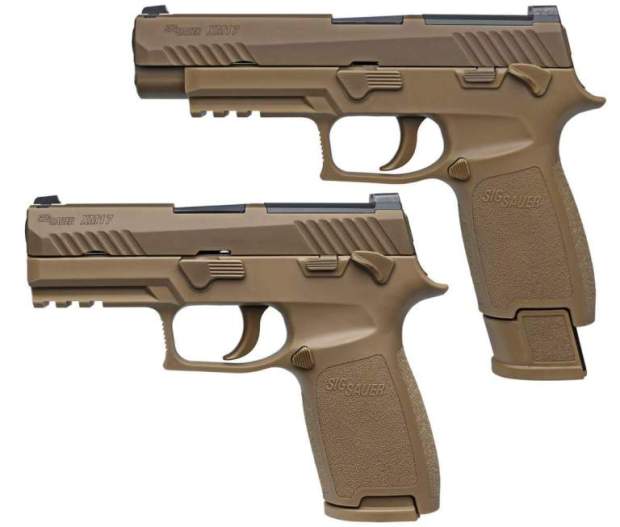
On 29 August 2016, the Army downselected the 9x19mm Glock and SIG-Sauer entries for the MHS.


On 28 September 2016, while everyone was waiting for the final MHS selection to be sorted out, the USMC went ahead and purchased Glock 19M pistols off of the FBI’s contract. The subsequently designated M007 were intended for use by the USMC’s Criminal Investigation Division (CID) and Marine One aircrews. (M67854-16-F-1144)
The Army awarded a MHS production contract to SIG Sauer on 19 January 2017. The decision came down largely to the massive difference in price – $102,705,394! Contrary to internet speculation, Glock was not eliminated due its single-model solution nor its lack of a chassis frame. If Glock had not met all of the requirements of the MHS RFP, its entry would have been eliminated long before the downselect for bidding.
Unsurprisingly, Glock filed a protest with the Government Accountability Office (GAO) on 24 February 2017. Glock challenged the Army’s interpretation of the solicitation regarding the minimum number of contract awards required by the RFP. In June 2017, the GAO denied Glock’s challenge, finding that the RFP allowed the Army to make one award.
The first deliveries of the XM17 were to the US Army’s 101st Airborne Division in November 2017.
In March 2018, the USMC announced its intent to replace all of its M9, M9A1, M45A1, and M007 pistols with the M18. The same month US Navy also announced their plans to adopt the M18 to replace both the M9 and M11. The USAF followed the trend in May 2018 by announcing its intent to order the M18 to replace the M9 and M11.
The US Coast Guard initially signaled its intent to adopt the MHS to replace its .40 P229. In September 2020, the USCG announced that it would instead order 9mm Glock 19 Gen 5 pistols off of a DHS contract.
In June 2021, the USAF solicited 3,015 SIG-Sauer P320 X-Compact conversion kits to make their M18 pistols more friendly for concealed carry. The conversion kits include a P320 Compact grip module (versus the taller P320 Carry grip module standard on the M17 and M18), the shorter P320 Sub-Compact slide/barrel assembly, and 15rd magazines.
 Scattered Shots
I’ll start off by saying that I love owning, maintaining and shooting my various handguns.
That out of the way, this seems like an enormous expenditure of scarce resources like people’s time and taxpayer money to acquire a weapon system that has very marginal utility on the modern battlefield.
Its been over 30 years since I hung up my boots, but in my ten years of service as a basic grunt I never encountered a situation where I thought a pistol would be a better choice of weapon than the SMG, M16, SLR, or M60 that I carried at various times. Or the radio…gotta love artillery! And in considering space and weight, I’d always have chosen a couple of extra mags for my main weapon versus schlepping a pistol around with me.
Now, Bn HQ people, AFV crews, Military PoPo etc would probably be better served by a pistol rather than a battle rifle, so there is a need for them. And obviously the pistol is great for executing the prisoners after interrogation, for example. But this level of procurement effort seems way out of proportion to the effect obtained on the enemy by the weapon system that was eventually procured..
Or, given that I’m Australian, and our army is different to the US Army and USMC, I may be wrong about all of the above. If so, I’d be glad if somebody could explain why I’m wrong, because this seems a bit odd to me.
LikeLike
the military loves to waste tax payer dollars. Some General officer got a cushy post retirement job at Sig for getting this pistol adopted. that is likely the only reason why
LikeLike
You’re not wrong. Remember there’s a vast defense acquisition system that has to “do something” to justify its existence. Quick, logical solutions would kill the bureaucracy.
LikeLike
Part of the problem here is that in a democracy (or a representative republic with universal suffrage if you prefer), nobody is actually in charge of the Fisc. Nobody is authorized to say, “This is a ridiculous, small problem and someone should just pick a pistol that’s popular with police departments that’s manufactured in the USA.” The difference between that and corruption is the difference between someone spending his own money and someone spending “the public’s” money.
So we get stuck doing ridiculous things because nobody is actually in charge.
LikeLiked by 1 person
Yes indeed. All this bullshit should’ve been replaced by the guy in charge saying “What? We need handguns? Order 50000 Glock 19s immediately”. Or SIGs, or S&W M&Ps or whatever.
LikeLike
Or, “let’s just let another contract to Colt (or whomever) to keep making 1911’s.”
There was nothing wrong with the 1911. Seriously, nothing functionally wrong with it. None of the veterans who actually used a 1911 in combat have ever voiced a complaint about that pistol to me, from the time I was 11 years old (and when a 1911 was put into my hands by a couple USMC vets of the PTO) until now. These were vets of WWII, Korea, Vietnam – they all said when they needed it, it worked and it killed whomever they pointed it at. Now, this lack of problems with the 1911 might be the result of the US Army having an outsized influence in the choice of sidearms, and all of the vets I knew/know who used the 1911 in actual lethal combat are Marines… who knows?
There’s one gentleman in the town where I live that took a 1911 down into some tunnel systems in Vietnam when he was with the USMC there. No one, and I mean no one, can convince that gentleman that there is a better handgun that has ever existed, before or since the 1911.
The Beretta Model 92/M9? It’s an OK pistol, but it’s much more complicated than it needs to be. It’s a bear to detail strip, and it suffers from being made of aluminum and using roll pins, which will result in enlarged holes if you punch them out/in enough.
The Sig above? I have no opinion, as I’ve not had one on the bench yet. I like my Sig P365, but that’s a gun that gets “carried much, and shot little.”
The bullshit irony here is that the PowerPoint slide above calls out the reason for the RFP as “improving lethality for soldiers.” There’s only two ways to improve the lethality of a handgun for anyone using it:
1. Use a bigger round with heavier bullets, delivered with higher velocities. eg, move to a 10mm, or .45 WinMag round.
2. Supply a three-round burst setting, and design the pistol such that it could be controlled.
For the amount of time that a pistol is used as an actual weapon in battle engagements, the 1911 was doing the job. The supposed problems of the 1911 were invented by desk pilots.
LikeLike
I know I’m in a minority around here with my non-love for the 1911, but I think there are a couple of problems with the 1911 that made it not a great choice in the 1980s and even less of a great choice today:
1) Capacity – 7+1 is way below acceptable.
2) Complexity – The design has too many parts to be produced efficiently. An individual might be able to justify spending $750 instead of $500 on a carry pistol to get one he likes, but those Benjamins really add up when you buy them by the train car load.
3) Weight – Nuff said.
I think the Beretta was an OK choice in the 80s but likely not a great one. In 2017, negotiating some kind of plastic fantastic down to the lowest possible unit price was absolutely the way to go, even if I wouldn’t have picked the Sig, and the process was loony.
I do think the 9mm was a mistake for the military’s pistol. 9mm is a great round if you can use hollow points but the military (usually) can’t, and .45 ACP is an inspired choice if you are restricted to hardball.
LikeLike
You cannot say that the 1911 had “too many parts to be produced efficiently” and then replace it with the Beretta M9. The Beretta has more small and fiddly parts than the 1911, by far. Pull up an exploded diagram of a M9, and put that side-by-side with the parts diagram of a 1911. No comparison, the 1911 has about half of the parts inventory of the M9.
If you want a pistol that is simpler than the 1911, then there was a potential replacement that was under consideration in the 1920’s to replace the 1911: The Remington Model 53:
https://www.remingtonsociety.org/model-53/
Now that is a simpler pistol. Far fewer parts.
LikeLike
I thought the Beretta was comparable to the 1911 in parts count. Now I know better, and think even less of the Beretta.
But I think it’s hard to argue that the 1911 is easier/cheaper to manufacture than the plastic fantastics when you’re using a modern factory. The cheapest Sig P320 at PSA is $649.99 and the cheapest Colt 1911 at Bud’s is $921.99. Obviously that’s not the price that .gov would be paying per unit, but that’s a huge spread for a device whose ultimate use is launching pistol bullets. The military needs a satisficing solution here, not an optimized one.
LikeLike
There are at least three polymer-framed 1911’s in the market just now, and they’re all less than $600 retail.
There’s another thing about the 1911: The intellectual property rights were signed over to Uncle Sam over 100 years ago for the sum of $10 by JMB – as he did with all of his designs for the government. Uncle Sammy doesn’t need to pay “technical development package licensing fees” (as they did with the M-16 for years), or cough up patent royalties (as they did with the 1903 Springfield rifle, payable to the Germans, while we were at war with them). Uncle Sam can do anything with the 1911 design now.
Sure, a nice 1911 can cost you an arm and a leg. Even while Colt was making rough 1911’s for Uncle Sammy, it was also making high-polish Royal Blue variants for the commercial market; this latter group of guns is still a sight to behold even today.
I’m not saying that there aren’t better handgun designs since the 1911; I think the P35 Hi Power is a better design for a 9mm pistol. I’m just pointing out that the DOD is engaged in pointless RFP’s and bid responses for a weapon that is rarely used in combat, and for which the existing pistol worked just fine. It’s like the “caseless ammo” mental masturbation that keeps rattling around the DOD. Now, we have the DOD fielding not only a new rifle design that isn’t “caseless,” the cases are bimetallic and patented. More stupidity on the taxpayer dime.
LikeLike
Yeah, weight. From the point of view of an infantryman, if I had to carry a pistol I’d much rather it be as light as possible. I own a 1911, and it sure is a big heavy ole lump of steel.
LikeLike
your 2 complaint is one of ignorance and I won’t even address that.
the first complaint is debatable. a pistol is not an LMG or a rifle to lay down covering fire to break contact or clear a machine gun nest.
your 3 complaint is also debatable. how much does the average bayonet weigh?
LikeLike
the problem with the 1911 is that its old and out of style and not cool and black and plastic and its a fad to hate on it now. No one who ever used one is real truly horrific, meat grinder levels of combat conditions ever has anything bad to say about it.
LikeLike