By Richard H. Dick James
Before departing camp, I was warned that the terrain surrounding Cai Cai was honeycombed with VC mines, and to be on the alert. No amount of training will give a soldier true battle experience. The only way to get that experience, and learn if you can handle it, is to experience it, in the real world. I was about to live through that experience.
The military was great at training for combat by rote. Squads and platoons would line up and move in formation when practicing combat. There’s nothing cut-and-dried about actual combat. No two firefights were ever the same. One had to be able to adapt in actual combat, especially when dealing with unconventional enemy forces.
There was no established uniform, armament, or equipment to be taken on patrols or operations in Special Forces. All of us were intelligent, and savvy enough to determine, on our own, what was best to do. That being my first patrol in unfamiliar country I did, however, ask for some advice from the experienced teammates.
I was informed that, unlike conventional troops, we did not wear our helmets, or berets on operations. Instead, everyone wore soft caps, the kind of cap being up to the wearer. The helmets were deemed to be too heavy, too cumbersome, too hot, and prone to being noisy. They also reduced a soldier’s vision and hearing, which were essential in our situation.
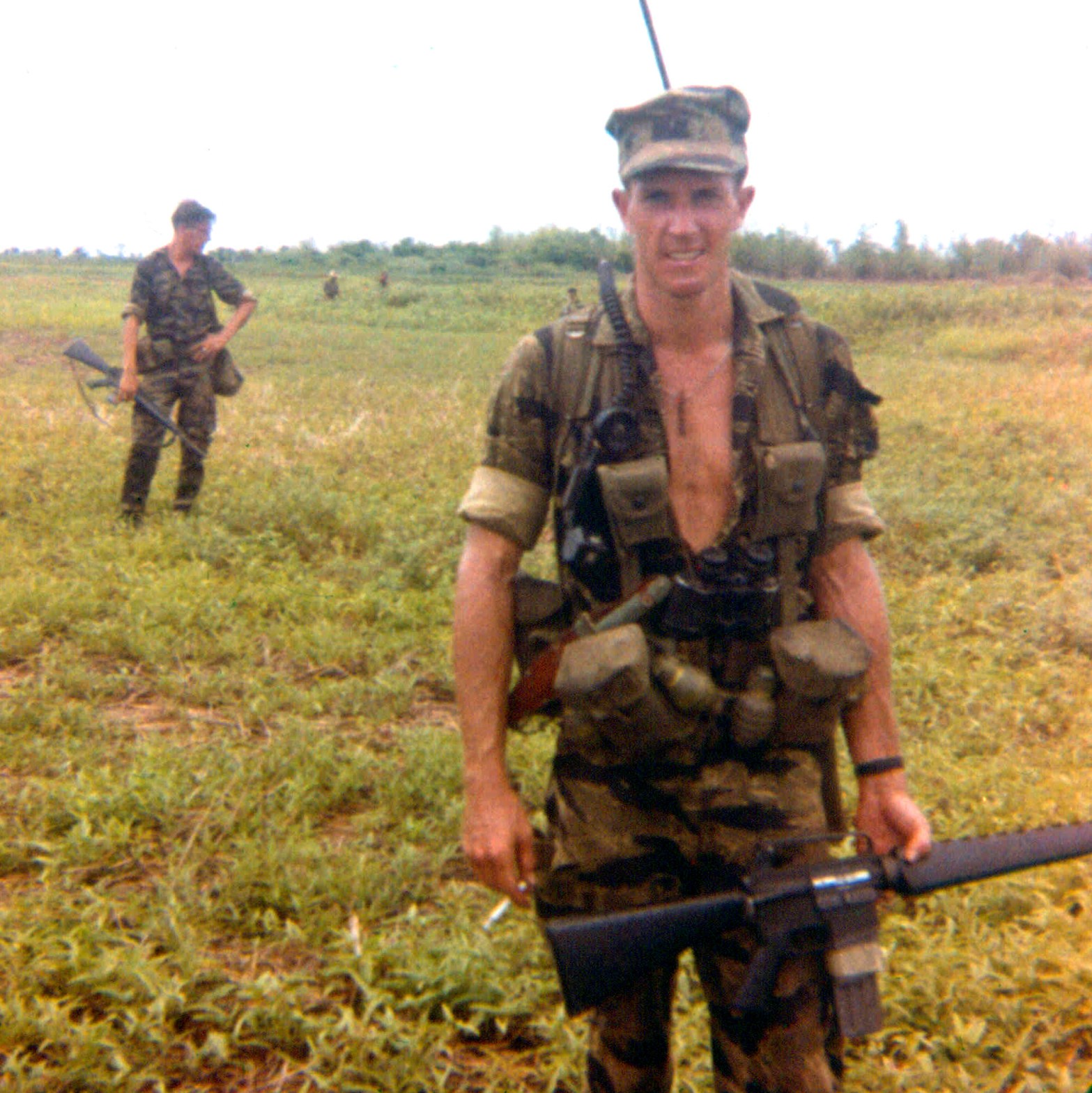
I wore a set of green tiger stripe camouflage fatigues, M1956 cotton canvas equipment belt and load bearing equipment (LBE) web gear, jungle boots, and a tiger camouflaged patrol cap with front visor (similar to a baseball cap).
We looked nothing like regular U.S. Army soldiers; more-so like irregular mercenary soldiers, in fact. It was no wonder regular Army soldiers and men from other services came up with so many different descriptive names for us (such as “sneaky Pete’s,” “spooks,” and “snake eaters”). Later in the year, when I arrived at Vinh Gia, I was able to replace the patrol cap with a much-preferred indigenous jungle hat (aka boonie hat), which was also camouflaged, but had a short brim all the way around the cap.
I was armed with my 5.56mm M-16 rifle and about ten 20-round magazines of ammo (two were in my rifle, while the other eight were in the two M-14 rifle ammo pouches attached to my web belt; four per pouch). I, as well as most other SF taped one pair of magazines together, bottom to bottom, upside-down, so that upon emptying the magazine in the rifle, all I had to do was pull the empty magazine out, turn the magazines over, and put the other, loaded magazine, in the feed opening.
That was what was loaded in my rifle. It saved a lot of time, since not taping them together would require getting the second magazine out of its pouch, a time-consuming operation. At the beginning of a firefight, firepower would make or break you, so quickness of reloading in those first few seconds was essential. It could be, in fact, a matter of life or death.
“You don’t hurt ‘em if you don’t hit ‘em.” —Lieutenant General Lewis “Chesty” Puller.
The M-16 had three firing settings: Safe, Fire, and Automatic. Upon leaving the camp perimeter I had the selector switch on “Safe,” with my thumb on the switch, ready to immediately push it to the “rock & roll” (Automatic) position, and my right index, trigger finger, alongside the trigger. That would afford me the most immediate firepower in case of being ambushed.
Heavy firepower was always a saving grace in cases of unexpected combat, such as being caught in an ambush. The “Fire” setting permitted only single shot firing of the weapon, one round per pull of the trigger. The “Safe” setting kept the weapon from being accidentally fired.
I was going to be the patrol’s grenadier, carrying a 40mm M-79 grenade launcher, aka “blooper” or “thumper,” with thirty 40mm grenades carried in five special bandoleers, which I slung over my shoulder. The M-79 was lightweight, a great weapon to have for medium distance combat firepower; a shoulder-fired 40-mm piece of artillery, if you will.
The M-79 was designed to replace rifle grenades, with a maximum effective area target range of about 380 yards, 165 yards if you were going for accuracy. Weighing in at six pounds and only twenty-nine inches long, some units (covert recon in particular) shortened it even more, replacing the stock with a pistol-style grip.
The M-79 filled in as light artillery for distances between hand grenade range and mortar range. For safety purposes, the round didn’t arm until it had traveled twenty to thirty yards. That was especially critical in a jungle environment, where the round could strike an object, detonating among friendlies.
Numerous different rounds were available for the weapon, including HE, buckshot, tear gas, and numerous different colored smoke and flare for signaling. I always carried HE rounds. The HE round had a casualty radius of only 5½ yards. I preferred hand grenades for casualty production, but the M-79 had a much better range. The somewhat loud, deep “thunk” sound of the grenade round firing, and the louder “krump” of the explosion were music to my ears.
Additionally, I took some explosive charges, a couple M26 fragmentation hand grenades, an M18 colored smoke grenade (the grenades hung from our web gear by their safety levers [“spoons”], definitely not the recommended method of carrying), Air Force survival knife, folding lensatic compass carried in an M1943 first aid pouch, first aid field dressing in an M1956 OG (olive green) first aid pouch, a can of serum albumin (blood volume expander to restore and maintain a severely wounded man’s blood pressure until medevaced), acetate-covered map (to protect it from the elements) of the AO (local area of operation), and plastic canteen.
Taped to the canteen was a small bottle of Halazone water purification tablets to make water obtained outside of camp potable. I felt that was important, because if I was ever separated from a unit, and had to E&E (escape & evade), I could at least purify any water I needed. We never carried equipment that we knew we probably wouldn’t use. We wanted the lightest load possible, so we could be maneuverable and quick. That meant no packs, entrenching tools, ponchos, tents, etc.
Our CIDG troops were armed with vintage World War II-era American-made M1 .30-caliber, air cooled, semi-automatic, gas operated, magazine loaded (15 rounds per magazine), shoulder fired carbines. The carbines had a maximum range of 2,200 yards, and a maximum effective range of 275 yards. They were perfect for the small statured Vietnamese, as they were very lightweight (5 pounds, 8 ounces), simple to operate, and very reliable.
A couple of the CIDG were carrying .30-06-caliber M1918A2 Browning automatic rifles (BARs, basically, machine guns). The BAR was a large, heavy (19 pounds, 6 ounces) weapon. It was a ludicrous sight, seeing it carried by a small Vietnamese soldier. It came equipped with a removable bipod, which made it easier to steady the weapon when fired prone on the ground. The weapon had selective fire, with settings of slow and high rates of fire. It was easy to empty a BAR magazine quickly during combat because the magazine only contained twenty rounds. The CIDG also had a few .45cal M3A1, submachine guns, commonly called “grease guns.”
From Book #3, of my four-book set of “SLURP SENDS!” Books #1 (“SLURP SENDS! On Becoming a Green Beret Book 1”). #2 (“SLURP SENDS! Experiences of an A-Team Green Beret Book 2”), #3 (“SLURP SENDS! Experiences of a Green Beret Vietnam Veteran Book 3”) and #4 (“SLURP SENDS! A Green Beret’s Vietnam Experiences Book 4”) are all available on Amazon, or from me.
I am proud to announce that all four of my books, as well as my collection of approximately 900 photos taken by me, my teammates, and friends were requested by, and are now in, the U.S. Special Operations Command (USSOCOM) HQ historical archives.
PHOTO: My M-16 double magazines taped together / My tiger fatigues & cap (my photos)

 Scattered Shots
The strongly worded advice I received one memorable day from a Vietnam veteran Warrant Officer was to never tape magazines together as described here, because when you hit the ground in contact you’re very likely to bang the upside-down mag into the deck. This will cause shit to get into the mag, damage the feed lips, dislodge rounds and generally cause bad things to happen when you rotate that mag into the weapon.
That was 40 something years ago now, and I still remember it like it was yesterday. :shudder:
LikeLike
I am going to go out on a limb here and say guys did that more because they thought it was cool than any real serious thought on it. They did it in WW2 Audie Murphy had his thompson mags taped together in his movie, I bet that had an over sized influence on the fellas back then
LikeLike