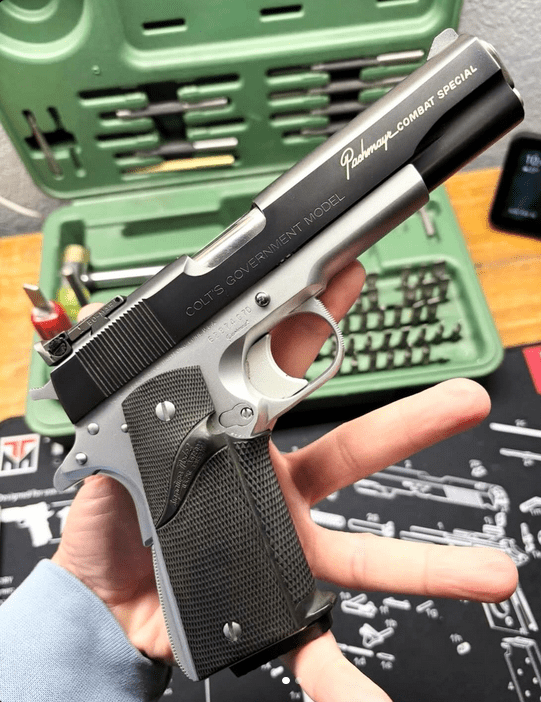
In the early 1930s, Frank Pachmayr left his father’s rifle business and opened his own shop. It didn’t take long for him to become interested in accurizing 1911s for bullseye shooting. Frank poured all of his time and effort into refining accuracy, ultimately focusing on what became known as the Signature System. Standard Pachmayr bullseye pistols were guaranteed to shoot 3-inch groups at 50 yards—impressive for the era—but Frank pushed for something more ambitious from the Signature. To achieve this, the Signature incorporated a complex system: a nosepiece with a Messerschmitt-style barrel ring and a slide-tightening yoke that wrapped up and around the receiver in front of the trigger guard. In theory, it should have worked. In practice, however, it created a frustrating paradox. Tightening the system improved accuracy but caused drag on the slide, compromising reliability. Loosening it restored reliability—but at the expense of accuracy. Enter Tom Dornaus, yes the Bren Ten guy. Originally hired to repair Signature models Dornaus quietly developed a different approach. On his own time, and without Frank’s knowledge, he built a prototype 1911 capable of shooting 1 inch groups, without all the complicated Signature bullshit. That pistol became the legendary Combat Special and the rest is history. The Combat Special was more reliable and delivered outstanding accuracy—everything shooters actually wanted. Frank, understandably, was disquieted by all of it. After years of investment in the Signature system, the market had spoken. When Ray Chapman chose a Combat Special as his prize for winning the first IPSC Championship, it underscored the shift for good. Most PCS were built by Craig Wetstein, with assistance from Mike LaRocca. When Wetstein left to open his own shop, Paul Liebenberg stepped in to complete the remaining production run. From 1974 to 1984, approximately 250 Combat Specials were produced (per LaRocca), though some estimate the true number may be higher. Regardless of the exact figure, these pistols earned their name—they are special. Demand reflected that reality, with wait times stretching beyond seven years. Here’s a relatively unfired one.
 Scattered Shots