From Pre64win
Knowing the details of when your rifle was manufactured and what production generation your rifle is from is essential knowledge for every model 70 owner. Whether you are buying parts, or just trying to understand how your rifle fits into the model 70 family of rifles, it begins with knowing when it was made. This Campfire article explains how to find your rifle’s place in model 70 production history.
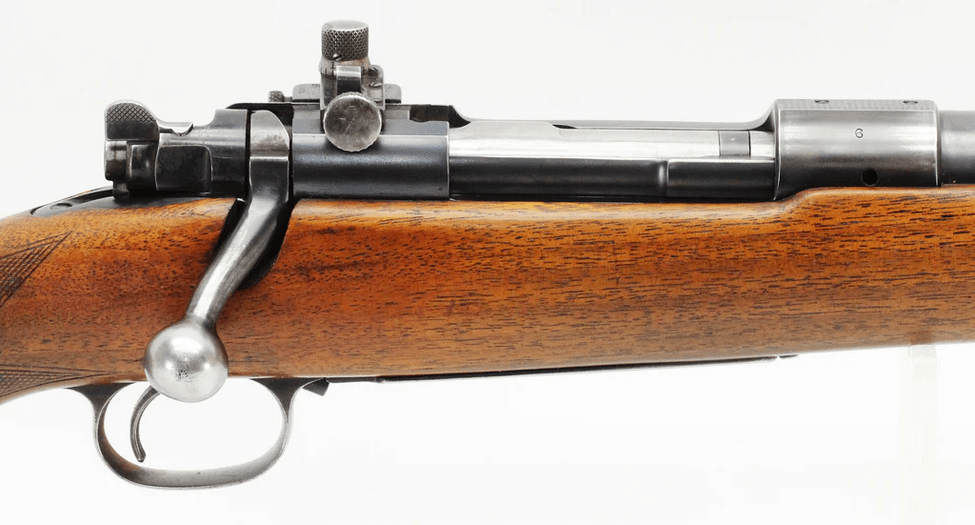
 A factory original and all correct Type I-1 rifle from 1936
Pre-64 model 70s are commonly classified into one of three production groupings, framed around WWII. These groups are “pre-war” and “post-war”, with a small number of rifles between these two groups referred to as “transition” rifles. In Winchester parlance, these three groupings of rifles are referred to as “Type I”, “Type II” and “Type III” rifles.
| Production Period | Approximate serial number range | Notable characteristics |
| Pre-War or Type I | 1-66350 | A receiver featuring a cloverleaf tang, a clip-loading slot, and a recessed and roll-marked rear bridge. Also present is a distinctive flag shaped safety lever and a stepped bolt handle shaft. |
| Transition or Type II | 66350-87700 | A receiver with a mix of pre-war & post-war characteristics – often a cloverleaf tang, but always a non-recessed rear bridge. No clip loading slot. No step on the bolt handle. Some transition rifles have a unique paw-shaped safety lever. |
| Post-War or Type III | 87700-581471 | These rifles have a tapered oval receiver tang and a non-recessed rear bridge which is drilled and tapped for a scope. These rifles also have the dog-leg shaped safety lever still found on current model 70s. |
While these three broad production periods can be a useful frame of reference to differentiate between major production eras, you will need additional information to fully understand your rifle.
Within the three major groupings above, there is a much more refined breakdown of the model 70 which takes note of numerous minor style changes. These refined groupings divide the pre-64 model 70 into ten sub-types
| Generation | Approximate serial number range1 | Distinctive features |
| Type I | ||
| Type I-1 | 1-3600 | A square, un-beveled magazine release button |
| Type I-2 | 3600-8850 | Changed from square magazine release button to beveled |
| Type I-3 | 8850-20500 | Added the safety retaining pin to the bolt sleeve |
| Type I-4 (Std) | 20500-66350 | Changed from carbonia charcoal blued receiver to bead blasted black oxide bluing |
| Type I-4 (H&H) | 20500-63200 | Changed from carbonia charcoal blued receiver to bead blasted black oxide bluing |
| Type II | ||
| Type II-1 (Std) | 66350-87000 | Clip loading slot eliminated2. Receiver bridge changed to smooth |
| Type II-1 (H&H) | 63200-87000 | Receiver bridge changed to smooth |
| Type II-2 (Std) | 87000-87700 | Changed to dogleg safety and bolt handle modified for safety clearance |
| Type II-2 (H&H) | 87000-1217003 | Changed to dogleg safety and bolt handle modified for safety clearance |
| Type III | ||
| Type III-1 (Std) | 87700-180000 | Receiver tang change from cloverleaf to rounded / tapered with bridge drilled and tapped for a scope4 |
| Type III-1 (H&H) | 121700-180000 | Receiver tang change from cloverleaf to rounded / tapered |
| Type III-2 | 180000-225000 | Bolt release changed from notched to rounded |
| Type III-3 | 225000-445000 | Hole added to bottom of bolt handle knob |
| Type III-4 | 445000-581471 | Right side of bolt sleeve changed to rounded |
1 Serial numbers represent when the change was first introduced. It is common for older features to continue to appear until existing parts were depleted, resulting in some overlap of features.
2 Clip loading slots were retained on National Match/Target Model/Bull Gun receivers in 30-06 only.
3 From 1948 to 1949 the serial numbers of type II-2 and III-1 H&H magnum actions overlapped.
4 The bridge of H&H length actions was not routinely D&T for scope mounting until late 1950, well into type III production.
A final reference point which is important for you to know regarding your rifle is the production year.
Most Winchester factory records for the model 70 have been lost or destroyed, which means there is less production information available for the model 70 than for most other Winchester rifles. What records do exist leave some room for interpretation about the exact production date of any given pre-64 model 70.
In the absence of factory records, it may seem logical to regard the date stamp under the chamber area of the barrel as a way to date a rifle (these stamps were present on the model 70 until 1956). However, these stamps indicate the year of barrel production only, and not the rifle. Barrel production preceded the rifle and these barrel dates commonly precede the manufacture date of the rifle by a year, and sometimes by many years.
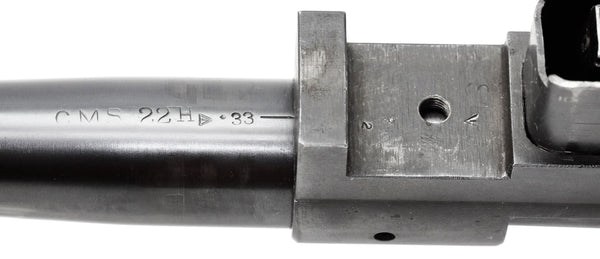
This 1933 stamped barrel was delivered from the factory on a 1942 rifle
The cross reference below provides an estimated production date by serial number, based on model 70 polishing room room records. Polishing room records documented when each receiver was polished and are the most complete model 70 records in existence. However, polishing was just one step in production, and not the final step. As a result, the polishing room dates somewhat precede the date each rifle was completed and ready to leave the factory. The list below is based on polishing room records, but adjusted based on other available information to provide a very close estimation of when any given rifle left the Winchester factory.
| Year | Serial number range | Quantity produced |
| 1936 | 1 – 2238 | 2238 |
| 1937 | 2239 – 11573 | 9335 |
| 1938 | 11574 – 17844 | 6271 |
| 1939 | 17845 – 23991 | 6147 |
| 1940 | 23992 – 31675 | 7684 |
| 1941 | 31676 – 41753 | 10078 |
| 1942 | 41754 – 49206 | 7453 |
| 1943 | 49207 – 49983 | 777 |
| 1944 | 49984 – 49997 | 14 |
| 1945 | 49998 – 50921 | 924 |
| 1946 | 50922 – 58382 | 7461 |
| 1947 | 58383 – 75675 | 17293 |
| 1948 | 75676 – 101680 | 26005 |
| 1949 | 101681 – 131580 | 29900 |
| 1950 | 131581 – 173150 | 41570 |
| 1951 | 173151 – 206625 | 33475 |
| 1952 | 206626 – 238820 | 32195 |
| 1953 | 238821 – 282735 | 43915 |
| 1954 | 282736 – 323530 | 40795 |
| 1955 | 323531 – 361025 | 37495 |
| 1956 | 361026 – 393595 | 32570 |
| 1957 | 393596 – 425283 | 31688 |
| 1958 | 425284 – 440792 | 15509 |
| 1959 | 440793 – 465040 | 24248 |
| 1960 | 465041 – 504257 | 39217 |
| 1961 | 504258 – 545446 | 41189 |
| 1962 | 545447 – 565592 | 20146 |
| 1963 | 565593 – 581471 | 15879 |
In a future Campfire article, we will dig into the wide variety of model 70 rifles Winchester manufactured and will cover how to determine the Winchester catalog codes for each of your rifles.
 Scattered Shots