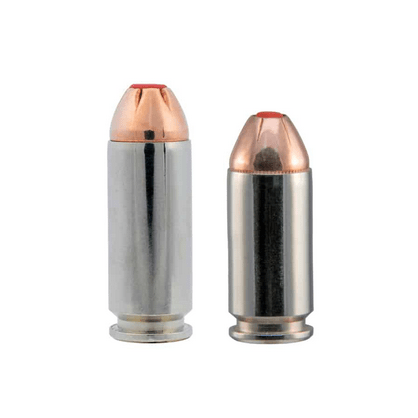
Originally, Tom Dornaus and Michael Dixon went to Jeff Cooper with the basic concept of making a CZ-75 clone in .45, and solicited his ideas. After making their initial prototype in .45, Cooper suggested a longer version of Whit Collins’ old .40 G&A wildcat. Covered in the June and July 1972 issues of Guns & Ammo, Collins had essentially created a prototype .40 S&W nearly two decades ahead of Smith & Wesson. The .40 G&A used cut-down .30 Remington cases and was chambered in a converted Browning Hi-Power.
While they couldn’t find a way to contact Whit Collins, Dornaus and Dixon did have copies of Collins’ original G&A articles. Dornaus and Dixon commissioned John Donnelly of Ballistek to make their first prototype ammunition from .30 Remington cases. Note that in early promotional materials, the early 10mm cartridges had slightly shorter cases than what we see today. With my uncalibrated eyeball judging against a neighboring .45 ACP case, the prototype 10mm case looks closer to 23mm than the final standard of 25mm.
Then it became a matter of finding a commercial ammunition manufacturer willing to complete its development. After US ammunition manufacturers refused to cooperate, Dornaus & Dixon finally succeeded overseas with Norma. When it came time to spec-out the 10mm cartridge for Norma, Cooper suggested a muzzle velocity of 1,100 fps, so that the projectile would be guaranteed to hit its target at a minimum of 1,000 fps out to 100 meters. When the concept of the Bren Ten Compact came up, he then suggested that the cartridge’s velocity be bumped up to 1,150 fps so that the short-barreled Compact could achieve the magic 1,000 fps impact velocity. Michael Dixon then told Norma to spec the cartridge for 1,200 fps, thinking that Norma’s test fixture barrels would run faster than the normal production pistol barrels. Norma must have added their own cushion to that figure, as they ended up delivering an early lot of 200gr ammo that clocked at 1,250 fps from the Bren Ten. Things ultimately calmed down a bit for later lots, but Norma 10mm ammunition was still very hot.
Dornaus & Dixon were undercapitalized for the task of trying to bring a new pistol and cartridge to market. Dornaus simply scaled up a CZ75, and then tweaked the design of individual parts by using other pistols as a baseline. It was engineering by a series of guesses. Dornaus & Dixon also made poor choices in vendors, more often selecting the vendor by the lowest price than from experience and quality. They mistakenly believed that their subcontractor for their investment cast slides and frames had worked with Browning, but the foundry had no experience with firearms. Other times they would develop parts with one company, and switch to another. One example would be how D&D first worked with Millett Sights’ parent firm to produce the Bren Ten’s small parts via Metal Injection Molding, and then switched to another MIM vendor. Even experienced vendors managed to disappoint. The prime example would be Mec-Gar delivering magazines without appropriate heat treatment.
After Dornaus & Dixon went bankrupt in 1986, the next company to take up the mantle of the 10mm cartridge was Colt, with the introduction of the Delta Elite in 1987. During the development of the Delta Elite, Colt simply could not come to terms with Norma on the bulk pricing of the ammunition necessary for testing. As a result, Colt started putting out feelers to ammunition manufacturers. Colt’s brand name was far more influential than Dornaus & Dixon, and thus, they were able to convince Hornady to produce the cartridge.
In regard to projectile weights, the initial Norma 10mm JHP loads were listed with 165gr projectile, but were later standardized on 170gr. As a result, most early full-power 10mm JHP loads from Hornady, PMC, and Remington used 170gr projectiles. Winchester had to be different with their 175gr Silvertip. Some projectile manufacturers were even looking at getting away from the 200gr FMJ; Sierra and Speer introduced 190gr solids. The 0.400″ 180gr JHP was introduced by Sierra in their Sports Master line circa 1988, the same year as their 150gr JHP. It was the 180gr Sierra that FTU SAIC John Hall used for his initial handloads. Federal Cartridge carried the Sierra projectile over when it developed its prototype 10mm Medium Velocity loads for the FBI. Given the FBI’s official stamp of approval for the 180gr JHP, most projectile manufacturers discontinued their 170gr JHP in favor of 180gr. The rise of the .40 S&W also helped speed the change.
SAIC John Hall of the FBI’s Firearms Training Unit used his personal Colt Delta Elite for the bulk of the Bureau’s initial testing of the 10mm cartridge from 1988 to 1989. The FTU would not receive pre-production 10mm prototypes from S&W until roughly February 1989. This was based on a converted 4516, a much smaller pistol than what would eventually be adopted. S&W would not commercially introduce its 10mm pistol line until 1990, starting with the full-size 1006. Note this was the same year that the 10mm Glock 20 was introduced, as well as the S&W 4006 and its companion .40 S&W cartridge.
The FTU quickly dismissed the Norma 170gr JHP load as nonviable before a 10mm pistol was even solicited. As a result, full-power 10mm ammunition was never a general issue item for the FBI. The FBI’s mid-velocity 10mm load was developed in December 1988, and was approved for adoption in February 1989. Solicitations for 10mm pistols were issued in May 1989. The Bureau wanted a steel-frame, traditional double-action pistol with a decocker but no manual safety. While several companies began development of 10mm pistols, the time frame for the solicitation was so short that out of the 21 firms expressing interest, only two manufacturers submitted test pistols: Colt and S&W. The S&W 1076 was selected over the Colt Double Eagle in January 1990. Field testing of production 1076 began in May 1990, with issue to new agents starting in July 1990 and the general issue to field agents beginning in December 1990.
The failure of the S&W 1076 falls primarily upon the FBI-spec trigger. The FTU wanted S&W to reduce the initial takeup in the trigger’s travel. However, the modification to the trigger’s hooks that engage the drawbar could result in the whole mechanism locking up hard. You couldn’t pull the trigger, cock the hammer, or cycle the slide. This actually happened to one agent in the field, ironically in Miami. Luckily, the incident had been resolved without the agent needing to use his pistol. There were a couple of similar lockups reported during range training. The 1076 were recalled for factory repair on May 31, 1991. Around October 1992, a number of the repaired 1076 were reissued to the agents who wanted to keep them, but by that point, the Bureau had given up on purchasing any more.
Yet, the FBI did not move directly to the .40 S&W. Rather, the FBI had already begun to issue SIG-Sauer P226 and later P228 in 9x19mm to replace the recalled 1076. The FBI drug its feet for years before authorizing agents to carry personally owned .40 S&W pistols. The first 40 S&W load that the FBI FTU approved for agent use was a mid-velocity 165gr, not the original 180gr load that duplicated the ballistics of their issue 10mm cartridges. The FTU didn’t officially select an issue .40 S&W pistol until May 1997. The Glock 22 and 23 were not issued to new agents until October of that year.
There is an excellent book titled “Bren Ten – The Heir Apparent” by the late firearm historian Ronald Carrillo. Carillo was able to interview many of the pivotal figures in the Bren Ten’s saga, including Jeff Cooper, Thomas Dornaus, Michael Dixon, Whit Collins, and several other industry figures. The book also covers the various attempts to revive the Bren Ten design, other 10mm pistols, and the emergence of the .40 S&W, as well as other .40 caliber/10mm cartridge designs.
What may be easier to find online are Whit Collins’ later articles from the July/August and September/October 1985 issues of American Handgunner. American Handgunner has an online archive of its back issues in which every issue that is at least 30 years old has been posted. The July/August 1987 issue should be online soon, and this is relevant as it includes the story of Whit Collins’ updated .40 G&A wildcat, dubbed the “Centimeter.” Collins and pistolsmith Paul Liebenberg were pushing it as the next hot IPSC/USPSA cartridge. It would offer higher magazine capacity than the .45 and be safer to operate than hot-rodded 9x19mm and .38 Super. Again, there was the promise that high capacity 9x19mm pistols could be converted to the Centimeter, just like the previous .40 G&A. One of Liebenberg’s competition circuit friends was none other than S&W’s Tommy Campbell. Campbell kept trying to get his bosses to look at the wildcat, but the engineering staff claimed that it wouldn’t be feasible to convert any of their existing designs.
At some point, S&W President Steve Melvin decided to take a chance and cut a purchase order to Liebenberg for the conversion of a 5906 to the Centimeter wildcat. Combined with the timing of the FBI’s development of the mid-velocity 10mm, it soon became clear that the Centimeter had far more commercial value to S&W than as a competition cartridge. Of course, this led to the further development of the Centimeter into what we know as the .40 S&W. Note that S&W soon hired Liebenberg to run their new Performance Center, as well as John French, the gunsmith who had converted Whit Collins’ BHP for the .40 G&A back in the early 1970s.
The California Highway Patrol was the first to adopt the S&W 4006. The CHP began their search for a new service pistol in 1989, testing the pre-production S&W 1006 against the S&W 4516, 5906, 67, and 686. In the 1006, both the full-power 175gr Winchester Silvertip and the 180gr Federal Medium Velocity load were tested. The CHP would follow up in 1990, concentrating on testing 10mm and .40 S&W pistols head to head. These included the Colt Double Eagle, the S&W 1006. 1076, 4006 and 4026, and Glock’s pre-production Model 20, 22, and 23. The pre-production Glocks were damaged during CHP testing and were judged harshly as a result in their May 1990 report. Many credit the addition of the third frame pin to the damage seen in the CHP tests.
However, the first agency to adopt and issue the .40 S&W cartridge was the South Carolina State Law Enforcement Division (SLED). SLED was originally looking at adopting the Glock 17 and 19. After seeing the FBI’s tests, SLED’s head of weapons training, Lt. Jim McClary, wanted to add the 10mm Glock 20 as an option. Fortuitously, SLED firearm instructors were attending Glock’s armorer and transition training during or just after the SHOT Show in January 1990. Glock’s staff promised that they could deliver production pistols chambered for the new .40 S&W cartridge by May. As a result, SLED switched their order from the Glock 17 and 19 to the Glock 22 and 23.
 Scattered Shots