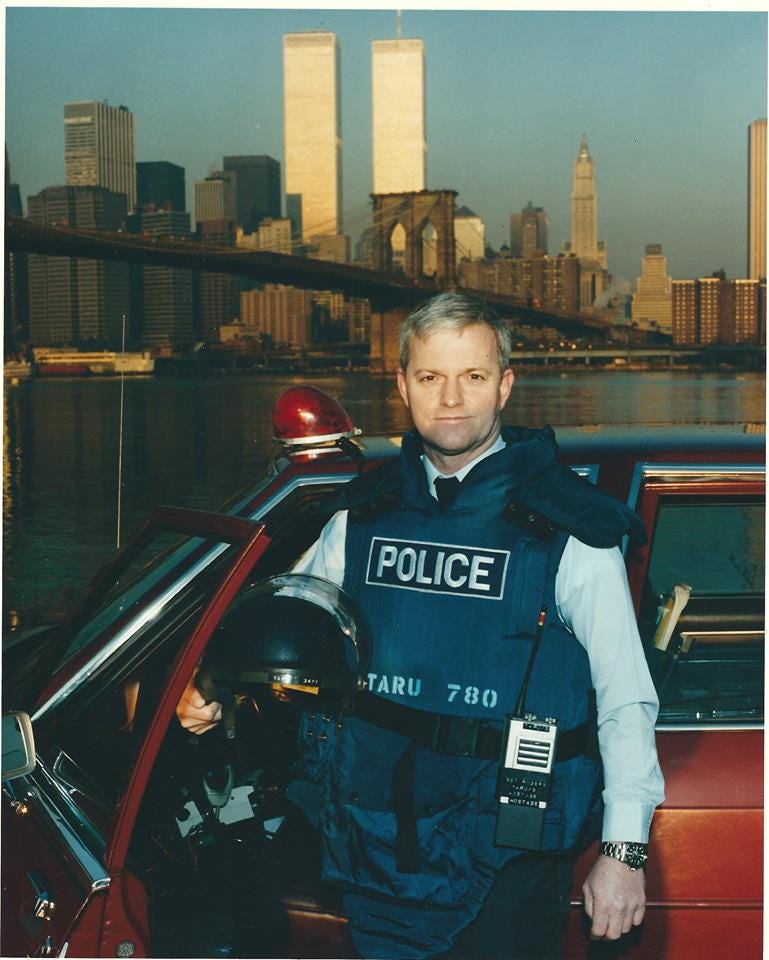
By: PATRICK A. ROGERS (RIP) for Tactical Shooter magazine, which ran this article in their June 1999 issue
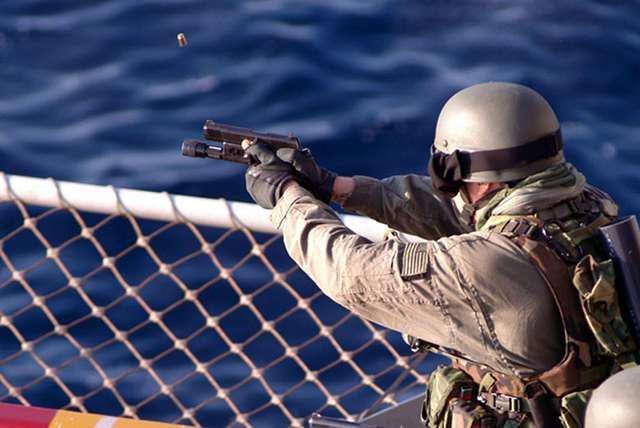
Until relatively recently, the role of the pistol in the military has been relatively minor. Civilians (to include police officers) carry pistols because they are small, convenient, unobtrusive, and non-offensive in appearance. For police administrators, the pistol is most often a badge of office. In the military, a pistol is usually issued only to officers and senior NCO’s as their job is supposed to be to lead, not to become involved in personal combat. Other’s, whose particular Military occupation Specialty (MOS) does not involve direct combat, will be issued a pistol for personal defense. These include Corpsman, communications, and those whose involvement is with other weapons, such as tank or air crewman, crew served weapons operators, etc.
With the advent of Special Operations and Counter Terrorist/Counter Narcotics missions, this view has been altered. Military units tasked with such missions now carry a pistol as a secondary, or back up weapon. Paradoxically, civilian police are now more inclined to carry military style long guns to supplement their pistols.
Thanks for reading! Subscribe for free to receive new posts and support my work.
In the mid 1980’s, the Department of Defense mandated that the M9 pistol replace all other handguns in service. As with most DOD small arms acquisitions, there was much gnashing of teeth over what was apparently a political decision. In a Memorandum For The Record (MFR) written by the Program Manager – Small Arms, Marine Corps. In 1996, the author stated that “the Joint Service Small Arms Program Office (JSSAP) are going to replace the current M9 Service Pistol with some as-yet-unidentified, technologically superior weapon.”
He further writes, “that the entire JSSAP user community is dissatisfied with the current M9 Pistol due to an inefficacy of the 9mm caliber, a too limited duty life due to unacceptable wear, unacceptable slide failures in service and insufficient corrosion resistance”.
Instead of replacing all other handguns, it was necessary to bring additional weapons into the inventory. The M11 was brought in to fill criminal investigators need for a more compact pistol. Interestingly, champions of the M9 stated publicly that the 9x19mm cartridge generated less recoil than the .45 cal. round, and therefore was a better suited to females, and others of small stature. Bruce L. Jones, the Marine Corps Project Manager for Small Arms states, “If that were true, the best shooting would be done with a .177 pellet gun. What is at work here is physics. For every action there is an equal and opposite reaction. Up to a point recoil is your friend – more energy going down the bore is creating that recoil”.
In the February 1999 American Rifleman, the author of “America’s 9mm’s”, James P. Cowgill states, “One reason for the change to a 9mm service pistol was the increasing number of women in the military. They have statistically smaller hands and were often issued revolvers as opposed to the larger M1911A1”.
As the M9 has a significantly wider grip circumference and longer trigger pull than the M1911A1, it makes me wonder exactly what kind of thought process was going on. (My significant other is 5’0”, and 105 pounds, and carries a Kimber .45. She thinks that the .45 is just fine, thank you). It is the opinion of some in the Marine Corps that fully 1/3 of the Marines cannot acquire a proper firing grip on the M9 pistol.
In the Special Operations world, it became apparent that the 9x19mm round was insufficient for their needs. To this end several pistols were modified, or developed, to give operators a more efficient pistol.
Special Forces Operational Detachment Delta, the United States’ premiere hostage rescue organization, chose an in-house modified M1911 pistol. The Los Angeles Police Department’s SWAT, arguably the most progressive of all the American police teams, also utilizes an in-house modified 1911. Another modified 1911, built on a Para Ordnance frame by Les Baer, were purchased for the FBI Hostage Recovery Team. And recently, Springfield Inc. received a contract to build a modified 1911 for the Bureau’s Regional SWAT teams. Another unit in a U.S. Government organization whose mission includes Counter Terrorism also adopted a Les Baer modified 1911.
In 1990, Special Operations Command (SOCOM), which encompasses Army, Air Force, and Navy Special Operations assets, put out a Request for Proposal (RFP) for an “offensive” handgun, which resulted in the rather large MK23Mod0. This pistol does not fill the role of a secondary weapon for CQB use. It is a mission-specific pistol, designed by a committee to fill certain requirements. The buzz is that the pistol lacks only wheels to be crew served.
The United States Marine Corps has unofficially never been comfortable with the M9 pistol. Congressional mandates have allegedly proscribed Marines from bad mouthing this pistol, but the Marine Corps is continuing to look for a “unique sea service pistol” in .45 ACP. And, as the Marine Corps is not obligated to buy what the Army buys, this may well occur.
And while the Marine Corps has no assets assigned to SOCOM, they do have a special operations capability. In the mid 1980’s, a re-organization occurred, and the Marine Expeditionary Unit ((Special Operations Capable) (MEU(SOC)) was formed. Based around a reinforced Battalion Landing Team, the MEU(SOC) has a mission that includes Direct Action (DA), Vessel Board Search and Seizure (VBSS), Gas and Oil Platforms (GOPLAT), and In Extremis Hostage Rescue (IHR).
The core of this mission profile is the forward deployed Force Reconnaissance platoon. This group of highly trained, and extremely well motivated warriors has a mission that is almost equally divided between “green”, or conventional military special operations, and “black”, or unconventional operations.
The Force Reconnaissance Community did not want the M9 pistol. They wanted something more ergonomic, less bulky, easier to get into operation, and something definitely no 9mm. This was kicked around for a while, and eventually the Rifle Team Equipment Repair Shop, Weapons Training Bn., in Quantico, submitted a modified M1911A1 pistol. This was adapted as the MEU(SOC) pistol in 1987.
The 1911 pistol need to introduction. It has no secrets, and its history and operation are will documented. What concerns us here is the work performed to transform the stock 1911 into the MEU(SOC) pistol.
The MEU(SOC) pistol starts out as a stripped government contract M1911A1 frame, as manufactured up until 1945 or so. The frame is inspected, and the feed ramp polished and throated. The entire weapon is dehorned. All internal parts are replaced with current commercial items. King’s Gun Works supplies the beaver-tail grip safety and an ambidextrous thumb safety. This last piece is often thought of a s a superfluous device, added on as a de rigueur item on hordes of IPSC pistols. Here it has some usefulness. The pistol must fit any operator in the platoon, whether he is right or “wrong” hand dominant. Future rebuild pistols will have a “memory bump” on the grip safety. Currently, many operators are unable to depress the grip safety when having their thumb (properly) on top of the thumb safety. Some, understanding that your priority safety rests between your ears, have taped this useless grip “safety” closed. This is now forbidden, and will continue to present problems until the rebuild pistols are brought on line. Videcki aluminum Match triggers are installed, and tuned to a pull of between 4-5 pounds. Colt Commander hammers replace the standard spur hammer.
Slides are commercial contract. Initially, one vendor supplied all of the slides, but after the initial purchase problems developed. Caspian and Springfield Inc. currently supply all of the slides. The new rebuilds will have forward slide serrations to enhance chambered round verification (the oh so important press check).
Barrels are provided by Bar-Sto. The barrel bushings are form King’s Gun Works. The front sight is also form King’s Gun Works and is staked on. While many have shunned this method of front sight installation, preferring instead to dovetail it in, the Marine Corps has apparently got this procedure down right. I cannot ever recall seeing a front sight come off of the pistol.
The high profile rear sight is custom made at the RTE shop. This is an excellent unit, providing a good sight picture. It is secured to the slide by a hex head screw. The ejection port is lowered and scalloped to improve ejection. A fiber recoil buffer is installed. This controversial device is both cursed and praised. There is no doubt that the buffer absorbs some of the battering, but they do deteriorate, and debris can insinuate itself into the nether regions of the pistol. This does no appear to be a problem in the Marine Corps, as weapons maintenance takes on almost religious proportions.
Flat mainspring housings are used, and as these are working guns, a lanyard loop is added. The lanyard themselves are made by the operators. A commercial telephone cord, the snap hook from an issue lanyard, and cable ties work out nicely. Pachmayer rubber grip panels finish out the package. Once used on a lot of 1911’s, these are now considered to be somewhat Jurassic by some operators. There is no checkering on the MEU(SOC) pistol. This may be contrary to the exhortations of legions of pistolsmiths, writers, and wannabe commandos who insist that without such checkering the pistol will just slide and jump around in one’s hand when they are wet, bloody, etc.
It is interesting to note that some of Delta’s pistols sport skateboard tape over plastic grip panels. No checkering here either. The pistols come with the excellent Wilson-Rogers 7 round stainless magazines. This is another holdover form days gone by. Apparently, during some of the original testing, the then-new 8 round Wilson magazines failed to perform as required. Times have changed, and the 8 round Wilson appears as reliable as the 7 round Wilson, but the 7 rounder was approved, and continues to be issued to this day. The unit of issue is seven (7) magazines per pistol, and they are carried in Eagle pouches on the belt, and in a piggyback pouch on the load-bearing vest.
This may well seem like heresy to those concerned with the esoteric minutiae of the gun game, but the MEU(SOC) pistols are held to no particular accuracy standard. Indeed, they are the only combat weapons in the inventory with no accuracy standard specified. Rather, they are held to a strict reliability standard. The pistol must first of all go ban each and every time the trigger is pulled. This is a secondary weapon, to be used much like a reserve parachute. You may never need it, but when you do, you will need it badly. Close Quarter Battle, CQB, is by its very definition something that occurs at close range. If this pistol is to be used at all, it will be at conversational distance. While the wizards at the RTE Shop are certainly capable of building 1911’s to shoot tiny little groups, the trade off in reliability is not worth the operator’s life.
Having said that, most of the MEU(SOC) pistols that I have fired are capable of shooting 3” at 20 yards. That is more than sufficient to defeat an enemy.
The pistols are currently equipped with the Laser Product’s dedicated white light mount. This light supplements the Visible Light Illuminator and non visible infrared lights that come with the M4A1 Carbine, the operator’s primary weapon.
This light, while strong enough for police work, has had problems in some military environments. The Marine Corps has purchased the Insight Technology AN/PEQ-6 Laser Aiming Module (LAM) that is issued with the MK23Mod0 for the MEU(SOC) pistol. This unit has Visible Illuminator, an IR Illuminator, and visible and non-visible Aiming Lights. The existing frame will have to be modified to accept this unit.
The MK23Mod0 pistol comes with a Safariland holster that does not permit the pistol to be carried with the LAM mounted. As the MEU(SOC) pistol is a secondary CQB weapon, the light will have to be mounted in the holster. This will require a new tactical holster, sometimes not an easy deal.
The MEU(SOC) pistols are currently carried in tactical holster. These thigh type rigs put the pistol down on the leg, and out of the way of the body armor and load bearing vest (LBV). The excellent Safariland laminate holsters are most common (Models 3004 and 3005). The Model 6004 has proved somewhat fragile, as the stabilizing shroud can, and does, break.
These pistols are will used. The last one I was issued has 82,000 rounds in the gun book. This is not uncommon, s the Marines of Force Recon are hard shooters. During the 6 month pre-deployment work up, and the actual deployment itself, an operator will fire 20,000 to 40,000 rounds to acquire and maintain proficiency with his secondary weapon.
Therein lies a problem. Because The Force Reconnaissance Marines are not on the SOCOM nipple, for a variety of reasons, they operate with about 1/3 the funding of other similar sized elements in the community. The Marines are issued one of each set of weapons. They are expected to train with, and deploy with the very same weapons.
These are excellent pistols, but are subject to wear and tear like any other. During a recent pre-deployment workup, I observed pistols go down with a broken hammer, a broken barrel bushing, and a sheared locking lug on a Bar-Sto barrel. If a MEU(SOC) pistol goes down, it has to be evacuated to the RTE Shop at Quantico for repair. There is now an initiative to push maintenance down to the lowest level. That means that armorers with 2111 Military Occupation Specialty (MOS), at the Force Company level will be able to repair downed pistols on site.
Currently there are insufficient pistols to arm each Force Reconnaissance Marine. In the era of downsizing, funds may exist to design maternity uniforms, and purchase fancy office chairs with lots of levers, but not weapons. What is desperately needed is a second complete set of weapons at the Company level. One se would be for training and the second set would deploy with the platoon. In this manner, the Force platoon would be assured of a reliable, functioning weapon with which to carry out their mission. They also need to replace certain internal parts. The state of the art has advanced sufficiently that certain parts that were considered high breakage now have a lifetime warranty.
The Marine Corps figures that it costs approximately $2000.00 to build each pistol. It is money well spent. There are no surprises with this pistol. The 1911 design is old, but sound. It is a strong weapon, able to stand the rigors of combat, and fires a serious (for a pistol) round. It is arguably the prefect secondary weapon for those who operate in the harsh realities of Close Quarter Combat.
The MEU(SOC) pistol is one of the rarest of issued military weapons. There are probably less than 350 issued to operators, schools, and depots at this time. Not many civilians have any knowledge of this pistol. Even in the military there are few that have even heard of it, and fewer still have even seen it.
It remains as what might be considered the epitome of a fighting handgun, much like what LtCol Jeff Cooper envisioned when he designed the Gunsite Service Pistol (GSP) long ago.
There are no plans to replace this pistol.
Patrick A. Rogers
E.A.G. Tactical Training
40 Arcadia Place
Staten Island, NY 10310-2201
(718) 273-0953
Copyright © 1999-2002 PATRICK A. ROGERS