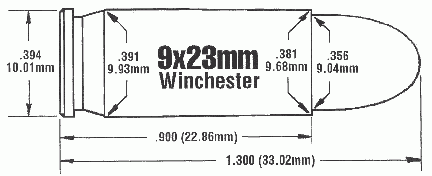
The 9×23 is one of those rounds quickly being forgotten with time. The idea was to offer up a round designed to win the various action handgun competitions. The case was stronger than the .38 super and so it can operate at higher pressures. It did away with the semi rimmed case of the super and over all would designed to eliminate the feeding problems of the Super.
The case is slightly tapered but not by much . Because of this you can get more rounds in a magazine than you can with it’s 9mm peers.
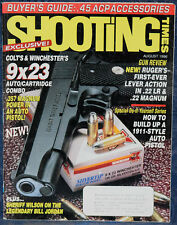
Announced to the public in early 1996 at an NRA convention, the 9×23mm Winchester cartridge was claimed to have the lowest recoiling load and still qualify for Major Power Factor designation in the IPSC.The IPSC Power Factor (PF) is equal to bullet weight in grains times muzzle velocity divided by 1,000. A PF of at least 175 was needed to qualify as Major within the Power Factor designation used within IPSC competitions. A Minor power factor carried scoring penalties and so there was an incentive to make the Major qualification. As the power factor calculation is proportional to bullet momentum and as the very large proportion of recoil is proportional to bullet momentum, it is immediately clear that the 9×23mm Winchester had essentially the same power factor and recoil as .45 ACP. The true benefit of the 9×23mm Winchester came from two things. Firstly, more rounds could be fitted into the magazine and that, in general, allowed fewer magazine changes to be made in the course of a contest task spread over multiple targets. Secondly, the higher operating pressure of the 9×23mm Winchester meant that a compensated pistol, where holes or slots in the barrel project high pressure gas upwards before the bullet leaves the barrel, had a greater ability to reduce the upward flip of the muzzle under recoil. That meant that users of the 9×23mm Winchester were able to return to target in less time than with a compensated .45 ACP pistol of otherwise identical design. Since speed was a major element in the scoring system within IPSC competitions there was an obvious advantage to the 9×23mm Winchester over the .45 ACP.
None of that really mattered in the end. Some complex law suits and delays meant that the round never really caught on before rule changes made the benefits of the round moot.
The 9×23 is used in pistols with the same sized frames for the .45ACP and the 10MM and performs better than the now nearly equally forgotten .357 SIG in factory specs. That also worked against it. Most people who CCW want to stick to a smaller lighter handgun and are willing to give up better performance for comfort and ease of carry.. Ahem..
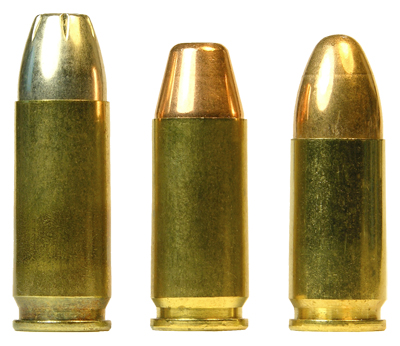
It was a neat idea for the time. And It still is. If you aren’t afraid of a full size gun it has a lot to offer for a variety of uses. It would be one flat shooting 9mm for hunting. recoil is comparable to the .45ACP so anyone can manage it. Pistol hunting deer or hogs with it would be pretty nifty, especially for hand loaders who have a nearly endless choice of bullets available that didn’t exist in it’s early years.
I have seen exactly two Colt M1911 chambered in the 9x23mm. The First was butchered by the owner to use the Safety Fast Shooting thumb safety abomination. This idiocy lets you carry the 1911 in condition one with hammer down and safety on. Deactivating the safety cocks the hammer. But if you don’t shoot and need to re-safe the gun, it turns into a nightmare maneuver. The owner was a retired Airforce Colonel who bought it to use in bullseye shooting. Strange choice, but he was ancient and died about a year later after buying it.
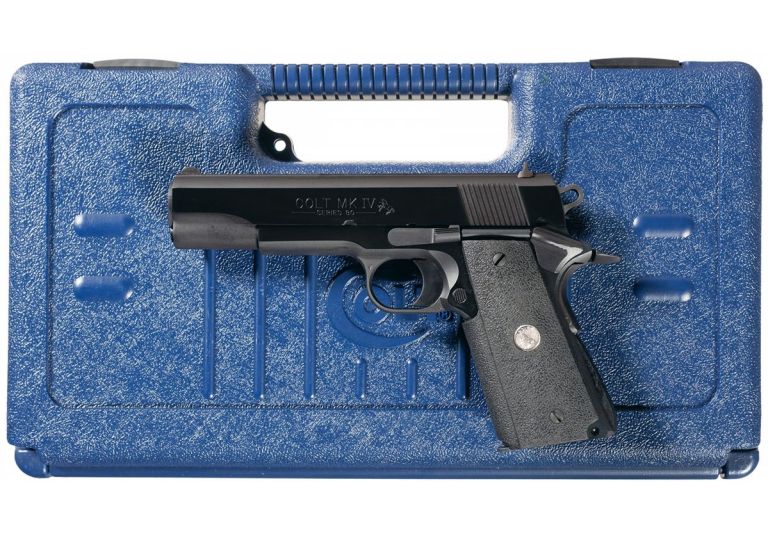
The second was the model on the cover of the slick gun rag pictured at the top. It was basically a Combat Target. That is to say a Gold Cup with a Matte finish and different roll mark. Very good guns no matter what round they chamber.
I never have gotten to shoot one yet. I would like to try one out to see what may have been had delays from law suits and production not kept it out of the competition world.


The gun industry keeps rolling out new cartridges in order to make money off chumps, particularly in rifle calibres.
I mainly shoot a 98 Mauser chambered in 6.5×55 Swede, first released in 1896. It’s the ballistic twin of the 6.5 Creedmoor which is the latest fad, so I see no need to “upgrade” to a Creedmoor. Meanwhile there’s probably half a dozen other 6.5 chamberings out there….6.5 Grendel, 6.5 PRC etc. Mostly they won’t kill game sugnificantly better than my Swede.
Then, when fashions change, a few years later you’re left with a gun in .45 GAP, .357 SIG or whatever, and ammo costs a fortune if you can get it.
I’m not saying there aren’t some genuine improvements happening, but I think that old-school rounds like the Swede, .223, .270, .308, 30-06, 9mm, .45 ACP, .357 Magnum have a lot going for them, and I’d really need to be convinced of some significant advantages before buying a gun in a fancy new chambering.
This message has been approved by your local Fudd. 🙂
And I hope married life is treating you well Shawn.
LikeLike
remember that stupid remington electronic primer ammo that lasted about 5 minutes?
LikeLike
I actually disagree with your thesis. Your point is well-taken on pistol cartridges. The newest popular pistol cartridge is probably 5.7×28, which has been in use for over 35 years now. 10mm is after that, 1983. And among truly common chamberings, you’ve got new kid .357 at 1934, over 90 years ago.
But a lot of the new rifle cartridges are genuinely better mousetraps. To take your 6.5×55 example, while it’s a fine cartridge and can launch the long bullets, it requires a long action, whereas the .260 Rem and the 6.5 Creedmoor can fit in a short action. 6.5 Grendel can fit in an AR-15, though it’s an inferior cartridge to any of the above ballistically.
And the newer Creedmoor cartridges in their various sizes can generally launch long-for-caliber projectiles that their older brethren can’t, at least not consistently and in factory trim. (Think .260 Rem vs. 6.5 Creed, .243 Win vs. 6mm Creed, etc.) That might seem gimmicky, but if you’re trying to shoot at distance, the longer bullets give you measurably better range, and long bullets also give you better wound channels in some kinds of bullet design.
Does that mean throw away all the .243 Wins, or 6.5x55s? Of course not. Does it mean jump on every cartridge bandwagon that the manufacturers want to push down our throats? Of course not. But cartridge design has advanced since the 1890s and there are material advantages to newer chamberings.
LikeLike